
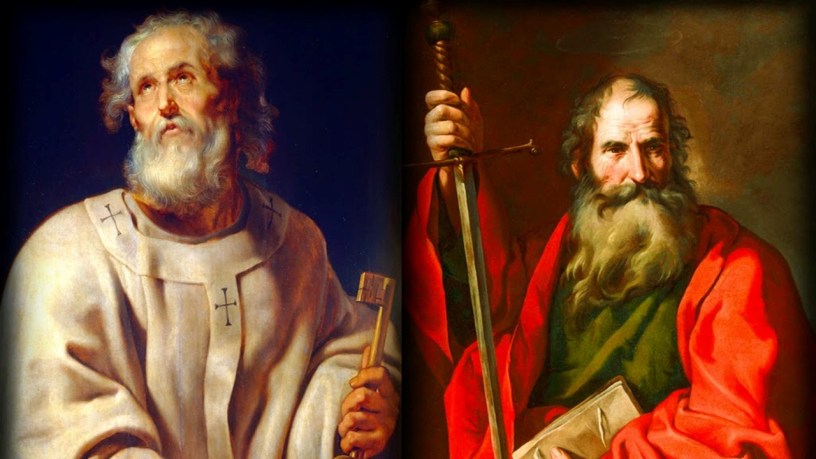
This is a copy of my talk given at Ayia Kyriaki and a joint service at Saint Luke’s in the Anglican Church of Paphos on Sunday 29 June 2025. The Bible readings were Acts 12:1-11, 2 Timothy 4:6-8 & 17-18 and Matthew 16:13-19.
Prayer
Heavenly Father,
I thank You for Your word.
By the power of Your Holy Spirit,
May You speak to my heart,
And change my life.
In the precious name of Jesus I pray.
Amen.
Introduction
Today we celebrate the two great apostles of the church, Peter and Paul. Two men around whom the mission to establish God’s Kingdom was centred and from whom it grew and spread to every corner of the world. Peter raised up the church from the faithful flock of Israel. Paul brought took the Gospel to the nations and became the great teacher of the early church. Each in his own way gathered the Church of Christ. One a fisherman. One a scholar. Both shared a martyr’s death. One crucified upside down. One beheaded like a Roman citizen. Both are praised throughout the Christian church.
Different Personalities
It’s interesting to compare the different personalities of Peter and Paul and as we do so we see that God called them to use their personalities to spread the Gospel. To use Peter’s impetuous love to look after the flock, and Paul to use his training as a Pharisee and his strength of character to ensure that the non-Jewish people would be welcomed into the Church. It is a reminder to us that we don’t have to be perfect for God to work through us, he can use our strengths, and our weaknesses, warts and all, as a means of helping others. Each one represents two very distinct roles of the Church in its mission to the world.
Impetuous Peter
Peter the impetuous one always seemed to speak before he thought! On the night before Jesus’ arrest he said he would die with Jesus (John 13:37) but later that night he denied he knew him. We also remember Peter’s objection to Jesus’ prediction that he would suffer and die in Jerusalem, when Jesus responded: “Get behind me Satan because the way you think is man’s way and not God’s way.” (Matt 16:23) Yet what made Peter a suitable candidate to serve was his love for Jesus. Remember Jesus asked him three times if he loved him before he asked him to look after the flock (John 21:15-19).
A Source Of Stability Peter represents that part of the Church which gives it stability: its traditions handed down from the very beginning. The structures which help to preserve and conserve those traditions which gives consistency and unity to the Church – spread as it has through so many races, cultures and diversity.
Fiery Paul
Paul was a controversial character with a fiery personality in his own way. In his early life he channelled that fire towards persecuting the Christians in Jerusalem, even witnessing the death of Stephen, the first martyr for Jesus (Acts 8:1). After his conversion, Paul’s preaching was fiery and upset many in the early Church. In Acts we read that Paul then returned to Tarsus, and Acts 9:31 says it all: “the churches throughout Judea, Galilee and Samaria were left in peace.”
Paul spent 10 years back in Tarsus before he began his preaching. It was a time for him to cool down and learn what the death and resurrection of Jesus meant for us all. Why did God call Paul? Paul was a highly educated Pharisee (Acts 22:3), and it would be only someone like him who could see that the Jewish expectations were fulfilled in Jesus. Paul had the strong personality needed for that daring challenge.
A Prophetic Role Paul, represents the prophetic and missionary role. It is that part of the Church which constantly works on the edge, pushing the boundaries further out, not only in a geographical sense but also pushing the concerns of the Church into neglected areas of social concern and creatively developing new ways of communicating the Christian message.
New Challenges
Our world today is changing and often with bewildering speed. Not only new technologies but new knowledge and new ideas continue to surface. And it’s not just Social Media is it: AI, ChatGPT, Grok … Our rapidly changing society means we need to share our faith in new ways. That does not mean that the Church is to conform to the ways of the world. Quite the contrary. What it does mean is that the Church’s evangelising work has to be in response to where people actually are and addressing the challenges they are facing. In the UK, that would be concerns for the vulnerable and elderly over the assisted suicide bill and also the unborn, given the recent change in the law. Amazingly, the CofE has been very quiet on these.
A changing world involves new challenges, a changing world brings about new social problems, new forms of poverty, of injustice, of exploitation and discrimination, oppression, a lack of freedom and the absence of peace.
If the Church is to remain relevant, if it is to continue speaking in a meaningful way to rapidly changing world, if it is to keep up with the new knowledge and ideas which change our ways of understanding the world in which we live, it has to renew itself constantly in the way it expresses its message, in the way it structures itself, in the way it communicates its message, in the way it dialogues with the world. Now, this might not be for all of us, you may not understand Facebook, Twitter/X, Instagram etc., but we should support those who do.
The world may not always like what the Church has to say but it should be able to understand it and be stimulated by it. Hence there have to be new ways of communicating and engaging and witnessing to the Gospel of truth, of love, of justice, of freedom, of peace. For this we need the prophetic role of the Church, built on the foundations of tradition and continuity.
God’s Empowering Presence
The readings today emphasise the presence of God in the work of his Church. Peter’s faith and acknowledgment of Jesus as the Messiah and Saviour are rewarded by his being made the foundation on which Jesus will build his Church. Through Peter, Jesus gives his Church a guarantee of never-ending protection. Down the centuries, the Church has been battered and countless efforts made to wipe it out, just as saw in Damascus last Sunday – and it continues to happen in Nigeria, Syria, Iran, Egypt – to name but a few. And as long as the Church remains faithful to the principles it received from Jesus, and the Apostles such as Peter and Paul, principles which are of the very nature of God and consistent with the deepest longings of human nature, it cannot fail. Truth and love cannot be suppressed.
The Only Thing To Do
We see that in the reading from Acts where Peter is thrown into jail for preaching the message of Jesus and the Kingdom of God. As Paul, who was himself in prison more than once, will say later, the word of God cannot be bound. Peter finds release and then goes back to the only thing he can do – proclaiming the Good News of Jesus. The miraculous release from prison symbolises that protection over his Church which Jesus had promised.
Fighting The Good Fight
Paul in the reading from 2 Timothy speaks first with gratitude of how his life has been spent in the service of his Lord. “I have fought the good fight to the end; I have run the race to the finish; I have kept the faith.”
May we be able to say the same as we approach the end of our life. Paul also speaks of how God continued to protect him through all kinds of trials and persecutions. “The Lord stood by me and gave me power, so that through me the whole message might be proclaimed for all the non-believers to hear.” He too knows that the Lord will continue to protect him, but he also knows that when his time comes, he is ready to go.
Paul’s love for Jesus is so intense that he finds it difficult to choose between staying alive and working for the Kingdom or dying and being reunited with Jesus. As he said once in a memorable phrase, “For to me life is Christ, to die is gain.” In either case, he is with his beloved Lord.
Ever Old, Ever New
As Saint Augustine said:
Both apostles share the same feast day, for these two were one; and even though they suffered on different days, they were as one. Peter went first, and Paul followed. And so, we celebrate this day made holy for us by the apostles’ blood. Let us embrace what they believed, their life, their labours, their sufferings, their preaching, and their confession of faith.
As we celebrate this feast today, let us both remain faithful to the traditions which have come down to us but, at the same time, let us be ever ready to make the necessary changes and adaptations by which the message of Jesus can be effectively communicated to all those who still have a hunger for the answer to the questions of life and death and the purpose to life here on earth.
Let Us Pray
Let us pray today for the whole Church all over the world; let us pray for the unity of Christians everywhere; let us pray for those who, while remaining faithful to the core traditions, are creatively finding new ways to proclaim the message of the Kingdom.
Let us pray for those places where the Church is working under great difficulties; let us pray for our own parish that it may be both loyal to the faith of the prophets and martyrs of our faith and let us pray that we may both individually and as a parish have a true missionary spirit to effectively proclaim Jesus to those among whom we live. Let us pray for the Peters and Pauls of today’s church. Those who treasure the faith and pass it on to others.
COPYRIGHT DISCLAIMER The text contained in this sermon (except where stated) is solely owned by its author, Revd Paul A. Carr. The reproduction, or distribution of this message, or any portion of it, should include the author’s name.
 revPACman