
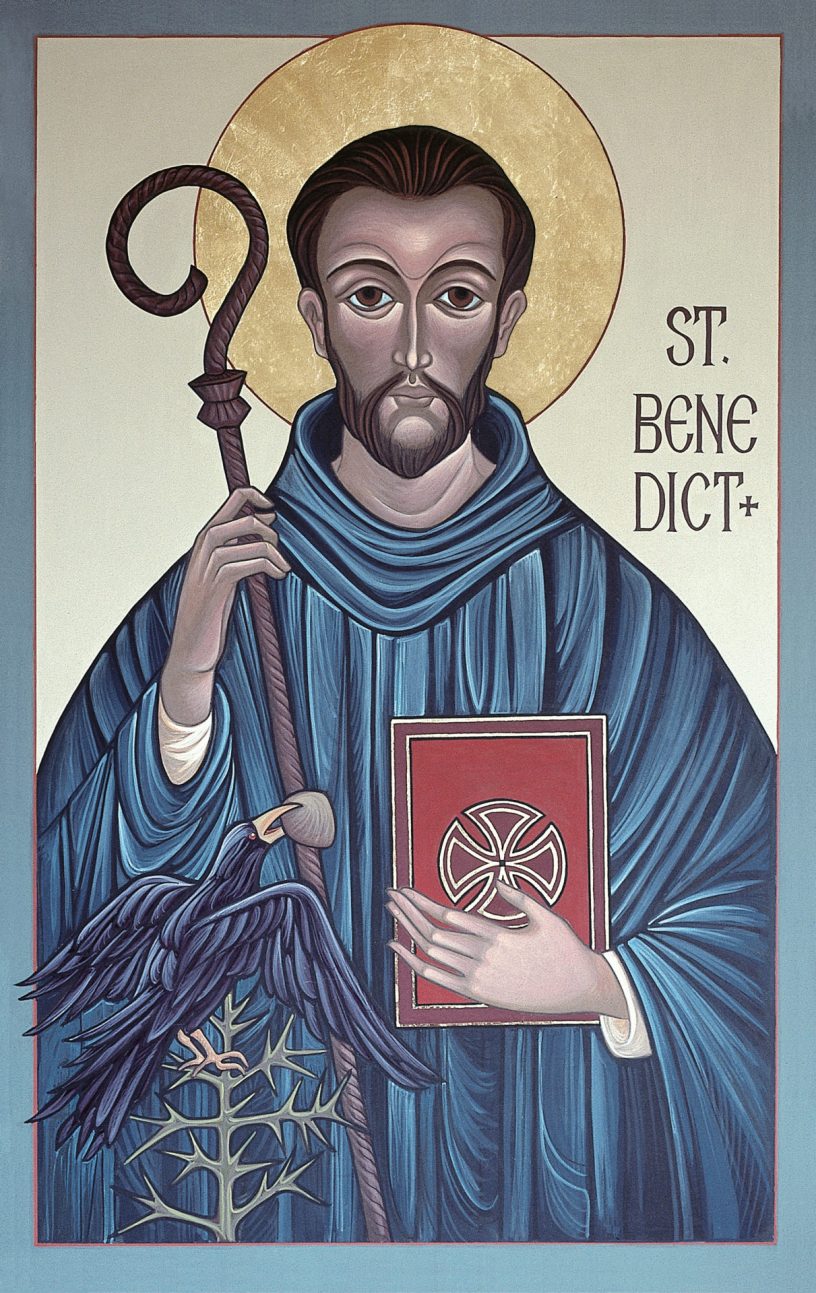
On 11 July the Church remembers Benedict of Nursia, Abbot, Patron Saint of Europe and Father of Western Monasticism, 480 – 543.
But who was Benedict?
Benedict the future, “Father of Monks,” was born in 480 A.D. in the region of Nursia, some 70 miles from Rome. He studied in the city, but found the hedonistic lifestyle of his companions overbearing, and withdrew to live as a hermit at Subiaco. As news of his life spread, he was joined by others, who formed an embryonic monastic community around him. Such were the numbers that joined him, that he eventually found himself directing twelve communities in the region of the Aniene Valley.
Rivalry and jealousy from local clergy eventually forced Benedict away from the area to Monte Cassino. He spent the last 17 years of his life establishing a monastery there, and during this time he wrote his ‘Rule of life’ for monks.
The Rule of St Benedict drew on ascetic tradition, including the ‘Life of Antony’, and the ‘Rule of the Master’. Benedict’s ‘Rule’ is not a list of instructions on how to live as a monk, but rather guidance offered in humility by a person of long experience in the Christian life.
Benedict places great stress upon the role of the abbot in any monastic community, emphasizing the incarnational element of such a leadership position. He stresses the importance of this role, and also highlights the required behaviour and attitudes of the one responsible for the whole community. Obedience to superiors is an essential element of Benedictine spirituality, as obeying the abbot’s directives and advice frees the other monks within the community to fully engage with, and worship, God.
Benedict stressed that the motive for all obedience is not fear, but love, ultimately, the love of God. Humility before others, and God, is paramount. His ‘Rule’ was clearly subordinate to Scripture, and Benedict had a strong belief in the necessity of orthodox practice.
Benedict taught that the spiritual side of a person could not be divorced from any other part. For him, the whole of life is spiritual, because God calls the whole person and the whole person is to respond to God. The Rule spread quickly throughout the West, and it is for this that he has become known as the ‘Father of Western Monasticism’.
If we do not venture to approach men who are in power, except with humility and reverence, when we wish to ask a favour, how must we beseech the Lord God of all things with all humility and purity of devotion. And let us be assured that it is not in many words, but in the purity of heart and tears of compunction that we are heard. Rule of St Benedict, Ch. XX
The Benedictine Order has given the Church over 57,000 known saints and 35 popes, of whom 17 are Saints or Blesseds. Pope Saint Gregory the Great – a Benedictine – wrote the life of Saint Benedict.
Saint Benedict’s twin sister, Saint Scholastica, founded an order for nuns based on the same rule of life. While praying one day, Saint Benedict saw in a vision the death of his sister and her soul rising toward Heaven in the form of a dove. She died on 10 February 10, 543 A.D., 40 days before his death on 21 March. They are both buried in the Cathedral of Montecassino.
A Prayer
Eternal God,
who made Benedict a wise master in the school of your service
and a guide to many called into community to follow the rule of Christ:
grant that we may put your love before all else
and seek with joy the way of your commandments;
through Jesus Christ your Son our Lord,
who is alive and reigns with you,
in the unity of the Holy Spirit,
one God, now and for ever. Amen.
Revd Paul A, Carr and extract from ‘Saints on Earth: A biographical companion to Common Worship’ by John H Darch and Stuart K Burns
Saint Benedict and the place of personal prayer
 revPACman