
This is a copy of my talk given at Ayia Kyriaki and Saint Luke’s in the Anglican Church of Paphos on Sunday 10 August 2025. The Bible reading was Luke 12:32-40
Prayer
Heavenly Father,
I thank You for Your word.
By the power of Your Holy Spirit,
May You speak to my heart,
And change my life.
In the precious name of Jesus I pray.
Amen
Introduction
General Charles Gordon was one of Britain’s most famous soldiers of the 19C – China/Khartoum/Crimea. He was also a Christian. The British government wanted to bestow honours and financial rewards upon him for his remarkable service, but he always refused. After some persuasion he eventually accepted a gold medal inscribed with a record of his thirty-three military engagements, which became his most prized possession.
After his death, the medal went missing. It was only when his diaries were unearthed it was discovered that, on hearing the news of a severe famine, he had sent the medal to be melted down and used to buy bread for the poor. In his diary he had written: ‘The last thing I had in this world that I valued I have given to the Lord Jesus Christ.’
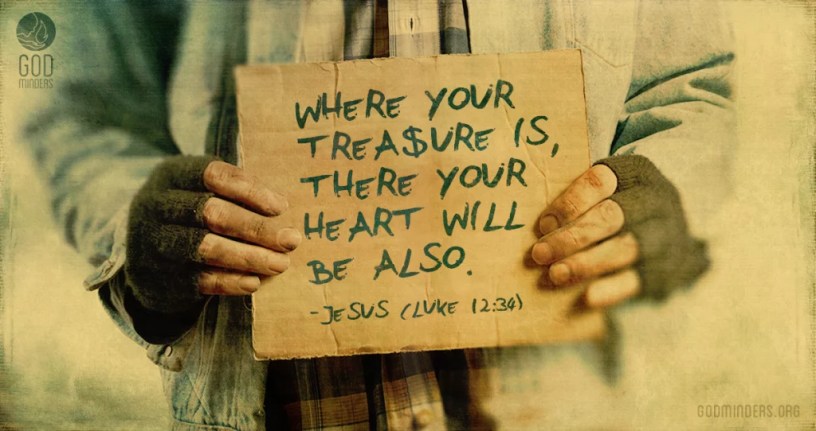
What could make him do such a thing? The answer, in part, is that he took seriously the teaching of Jesus, vs32-34: Sell your possessions and give to the poor … For where your treasure is, there your heart will be also.
There is often a fear of letting go of money because it feels as if we are letting go of something of ourselves and the security which is bound up with it. And given this link in our minds between ourselves and our money, the more money we have the more important and secure we think ourselves to be and, for some people, the less they feel the need for God. And that is a very dangerous position to be in.
It was John Wesley who once said, “If you have any desire to escape the damnation of hell, give all you can; otherwise, I can have no more hope for your salvation than that of Judas Iscariot.’ And remember that Judas Iscariot betrayed Jesus for 30 pieces of silver. We are not to think that Christians are not put in danger by money – they are. That is why 35% of Jesus’ teaching was about money and possessions.
And we are not to think Jesus had in mind those who were affluent, for, as we shall see in a moment, he is concerned about everyone who would claim to be his follower. Jesus doesn’t want our sense of value to be so bound up with our money and possessions that we are riddled with anxiety at the thought that by losing it we will lose our significance. So how are we to be freed from fear and freed to share? Jesus tells us …
- We are to cherish God as Father
If we view God correctly then we shall start viewing this world and our possessions correctly. If, along with some people, God is seen as a demanding tyrant who can’t be trusted, then we will cling to what we have for dear life. But if we start thinking of God as he really is, our heavenly Father, then we can relax our grip on things and extend our hands to receive what he generously gives and, in turn, open our hands to give.
I like the way Mike Reeves explains Jesus’ teaching when he writes:
Since God is, before all things, a Father, and not primarily Creator or Ruler, all his ways are beautifully Fatherly. It is not that God ‘does’ being Father as a day job only to kick back in the evenings as plain old ‘God’. It is not that he has a nice blob of Fatherly icing on the top. He is Father. All the way down. Thus, all that he does he does as Father. That is who he is. He creates as a Father and rules as a Father; and that means the way he rules over creation is most unlike the way any other God would rule over creation.
And like all good Fathers, God just loves to give. And what does he give? Well, lots of things – family, food, friends but especially His kingdom! When the Bible speaks about the Kingdom of heaven, it means that sphere of God’s rule in which we find salvation and love. This is where we find real security – for to be part of his Kingdom means that God will remain your Father in this life, come what may, and take you right through into the next life to be his special possession for all eternity.
And furthermore, our Father is the King of kings whose possession is not just a country or a nation, but an entire universe – and he says, ‘what is mine is yours’. And notice that God doesn’t do this begrudgingly but joyfully ‘for your Father has been pleased to give you the kingdom.’ He doesn’t sell us the kingdom or lend us the kingdom, he gives it, saying, ‘Here it is completely free as my love gift it is yours and you owe me nothing.’
- We are to live simply and give generously
v33a: ‘Sell your possessions and give to the poor’. Jesus is talking to His disciples. It seems an odd thing to command them to do. What possessions? These men were on the road most of the time, so they hardly had anything to sell. Sure, they still had homes back in Capernaum, and maybe James and John’s Dad managed to employ others to keep the fishing business going and they might have had a share in the profits. But Jesus says, ‘Sell your possessions’. What all of them or just some of them?
To the Rich Young Ruler he said, ‘sell everything.’ Zacchaeus gave half his possessions to the poor. In the Book of Acts Barnabas sold a field which he owned. You see, the disciples were not all that wealthy, certainly in terms of having disposable cash lying around. In fact, for many in this culture money was not all that accessible – save for buying and selling things, most of the wealth would be bound up in property, family heirlooms and the like.
We may think of the parable of the Prodigal Son where assets were liquidised so that he could clear off with his inheritance, or of the woman who anointed Jesus’ head and feet with very expensive perfume which was in all probability a family heirloom. Possessions had to be sold in order for money to be received in order for it to be given away.
- We are to focus spiritually and invest appropriately
Vs34, ‘…. provide purses for yourselves which do not wear out, a treasure in heaven that will not be exhausted, where no thief comes near nor moth destroys. For where your treasure is, there your heart will be also.’ Here’s a question to ponder: Why is it that we like to spend money?
We need to spend some money in order to live; we have to buy food, we have to pay rent, and we have to settle our bills and so on. But that is not the main reason you have people sleeping overnight for the Boxing Day or New Years Day sales or why people (or should that be women) love to spend hours at shopping malls on a shopping spree. The reason is that buying things actually gives us pleasure, it literally releases chemicals in the brain which make us feel good – but it can also become addictive.
But there is another pleasure we are to enjoy, investing in the bank of heaven. One of the main purposes of having money on earth is so that it can be used to secure treasure in heaven. I don’t think that you will get that many economists saying that is the purpose of money – but that is what Jesus is saying. You can have treasure on earth, or you can have our eyes on heaven. As Dallas Willard put it: The good news of Jesus isn’t so much about going to heaven when you die. It’s about going to heaven before you die.
- We are to live by faith
Hebrews 11 lists the patriarchs and matriarchs as examples of faith. Abraham and Sarah take a prominent place. In both Romans and Galatians Paul uses the example of Abraham as one who was justified by faith and not by works. Faith responds to the voice of God. God spoke and Abraham and Sarah obeyed, not knowing where they were going. The only property they owned was their burial cave. It would be 400 years before his descendants would take possession of the land God promised. They spent their lives wandering around as nomads. But Abraham wasn’t looking for a city which man had built, but rather God. We, too, by faith, store up our treasure in heaven.
I mentioned John Wesley earlier. Let me tell you a little bit more about him. When he was at Oxford, he had an income of £30 a year. He lived on £28 and gave away £2 which was 15%. Some years later his income had increased four times to £120 per year. He still lived on £28 and gave away £92, almost 77%.
Throughout my ministry I’ve consistently taught four principles about money:
- God owns all that we have: All things come from you, and of your own do we give you. 1 Chronicles 29:14.
- God has given us everything we have: The earth is the Lord’s and all that is in it. Psalm 24:1
- God is a giver and his greatest gift is Jesus: God so loved the world that he gave his only Son. John 3:16.
- Each of us are responsible to God for what we do with what he has entrusted to us: So, then each of us will be accountable to God. Romans 14:12.
This, it seems to me, is how John Wesley lived, vs34, ‘For where your treasure is, there your heart will be also.’ John Piper explains it this way:
How you handle your possessions shows where your heart is … and whether you will inherit the kingdom – the treasure in heaven that does not grow old. Selling your possessions and giving rather than accumulating more and more things for yourself is the pathway to the kingdom, not the payment for the kingdom. It is the proof that you love the kingdom more than possessions. That you trust the King more than money.
Conclusion
In closing, let’s hear the words of Jesus again, so we may be free to love and free to give, ‘Do not be afraid, little flock, for your Father has been pleased to give you the kingdom. Sell your possessions and give to the poor. Provide purses for yourselves that will not wear out, a treasure in heaven that will never fail, where no thief comes near and no moth destroys. For where your treasure is, there your heart will be also.’
COPYRIGHT DISCLAIMER The text contained in this sermon (except where stated) is solely owned by its author, Revd Paul A. Carr. The reproduction, or distribution of this message, or any portion of it, should include the author’s name.
 revPACman