
This is a copy of my talk given at Ayia Kyriaki and Saint Stephens in the Anglican Church of Paphos on Sunday 31 August 2025. The Lectionary Bible Readings were: Jeremiah 2:4-13; Hebrews 13:1-8, 15-16; Luke 14:1,7-14.
Prayer
Heavenly Father,
I thank You for Your word.
By the power of Your Holy Spirit,
May You speak to my heart,
And change my life.
In the precious name of Jesus I pray.
Amen
Most of us will have had to deliver bad news at some point in our lives. It isn’t an easy experience. I’ve had to deliver bad news on several occasions in ministry. Delivering bad news, of any kind, is never an easy task.
Yet, bearing bad news is an integral part of being a prophet and the focal point of the burdensome task to which God calls the prophet Jeremiah. Although restoration is God’s ultimate goal, the path toward restoration involves the devastating announcement that Israel’s world will be turned upside down. God gives Jeremiah the word of the Lord for the nation – first an indictment and judgment against Israel for worshipping other gods, and then a call for the people to turn from their sinful ways before it’s too late. God made several accusations against a people who struggled to keep their faith in day-to-day living.
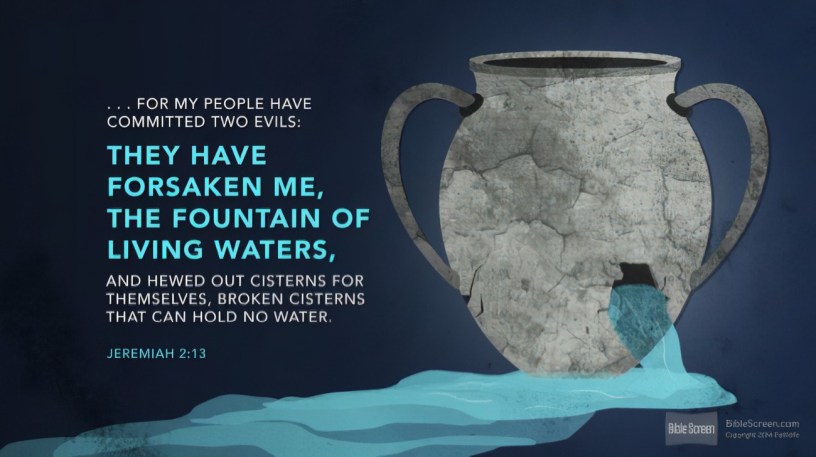
Jeremiah pointed out two reasons why God’s chosen people were accused. Firstly, Israel acted against common practice. Never in their history had the people forsaken the Gods of their inheritance. Second, they acted against common sense. Why did they take something of great value and exchange it for something that’s worthless? They had forsaken God, the fountain of living water for cisterns of their own making. The Israelites gave up everything and went after nothing.
Cisterns are reservoirs dug into the earth. They are usually made of solid rock and are designed to hold water when it rains. On the other hand, a fountain is a spring that bubbles up from the earth with an unending supply of fresh, pure water. Instead of choosing God’s living water, the Israelites, like us, chose to dig their own cisterns. When we choose our own way instead of God’s way, we realize it doesn’t work out because it is broken.
The leaders of Israel, the priests, kings and prophets, should have known better. They should have warned the people about the recklessness of not following the God who had brought them so far. But, in a stinging indictment, God details their failures. “The priests did not ask ‘Where is the Lord?’” There was no inquiring of the Lord in this new place, because in spite of the fact that the priests “deal with the law” they “did not know me.”
God wasn’t absent. The people and their priests ignored the God of Israel as they pursued other, pagan gods. The priceless heritage of the Promised Land was ignored in favour of idolatry. It’s not often Cyprus is mentioned in the Bible, as it is in 2:10, but not as a Bible Land but as an example of rejecting God’s plans and purposes for their lives.
We do the same thing today when we get caught up in our daily worries. We resort to coping strategies such as drugs, alcohol etc., as a distraction. Our broken cistern is a cheap substitute that is not better than the living water. We can choose between doing what we think will help us cope and drinking the water of life that can deal with the issue. When we exchange God for an idol, we are changed.
In the mid-noughties (2006) Gillian McKeith wrote the bestselling book ‘You Are What You Eat?’ Remember that? It also became a successful C4 TV series. Similarly, you could say we become what we pursue. If we pursue something that is empty, we will become empty. If we pursue vanity, we will become vain. If we pursue darkness, we are assimilated into the darkness. Technology has made our lives easier, but it is a broken cistern that can’t hold water and creates as many problems as it solves. What pursuits or ambitions lead you/me from the source of living water?
Thomas Merton: “People may spend their whole lives climbing the ladder of success only to find, once they reach the top, that the ladder is leaning against the wrong wall.”
Israel had been given the privilege of knowing God’s glorious presence. The people had known God as Yahweh, sovereign in their lives, and yet other nations had demonstrated greater faithfulness to their pagan gods. No one can blame God for their sin or for their wandering habits. As an old saying goes: You made your bed, and now you have to go and lie in it. Jeremiah warned that God’s people were trying to quench their cravings for salvation and looking for significance in the wrong places.
Where is the dryness in your/my lives? Where are the parched places that long for living water? Where have we foolishly looked to our own resources for life and turned away from the true source of living water?
Any prolonged pattern of sin, especially if it is practiced by people who claim to be devoted to God, leads to punishment from God. The Israelites turned away from the only true source of living water and created cisterns that could hold no water – even though living water was available.
We always make a bad deal when we exchange God for something else. If we choose something such as money, fame, power, pleasure or influence instead of God, we end up with nothing but trouble. God is the only One who can satisfy us with His Living Water.
Some people argue that religion is a broken cistern. Some people don’t see any difference between Religion and Christianity and think they are the same – but they are not. Religion is man’s way of trying to find God, whereas Christianity is God’s way of finding man! Religion gives us the impression that we are good. but it ignores the sin of the heart. Christianity focuses on our sin and of our need for a Saviour.
In Luke 14:1, 7-14 Jesus was invited to a banquet and when he arrived, he noticed that all of the important people in society were vying to get the seats closest to the guest of honour, while those of lower classes sat at the back. He warned the host for only inviting the elite and urged him to invite the less fortunate to his table.
Jesus said in Matthew 25:40, “Whatever you do for one of the least of these brothers of mine, you did for me”. We never know who the stranger is who crosses our path.
He/she might be an angel in disguise (Hebrews 13:2) in need of a helping hand or an encouraging word or company over a cup of coffee. The willingness to serve others is the greatest of all the values of the Christian life. Everyone is welcome at Jesus’ table.
A husband comes home from work on a Friday night and as he comes into the driveway, he sees that there is a tent in the back yard. Under the tent are tables and chairs for about forty people – there is a stage and a dance floor in one corner of the tent. Decorations are hanging everywhere. None of this was there when the husband left in the morning. Seeing all of these preparations and having them come as a surprise, what does the husband think?
One reaction might be panic: “It’s our anniversary, and I’ve forgotten about it!” After a few minutes, he might realise it’s not their anniversary, so he might say: “I guess all this must be for a birthday party”. Now suppose the husband walks into the backyard and finds his wife cooking a huge pile of chickens and choice steaks. He might think: “This is going to cost me a fortune!”
Then suppose his wife looks up, smiles and asks, “Guess who’s coming to dinner?” His guess might be “Relatives, friends, neighbours, business associates”. Before he can answer, she continues, “I’ve invited twenty men from the local homeless shelter and twenty clients of the local food bank. Don’t worry dear, you won’t know anyone, and best of all, not a single one is likely to ever pay us back”. Now given that situation, the husband might think his wife has lost the plot!
But in reality, she is following the words of Jesus in Luke 14:12-14. “When you give a luncheon or dinner, do not invite your friends or your brothers or your relatives or rich neighbours, in case they might invite you in return, and you would be repaid. But when you give a banquet, invite the poor, the crippled, the lame, and the blind. And you will be blessed, because they cannot repay you …”
Don’t sit at the top table. Start at the bottom. This parable isn’t advice from Jesus about behaviour at dinner parties. It’s Jesus’ great challenge to the Israel of his day. If Israel thinks she has an inalienable right to sit at the top table, she has another thing coming. Pride comes before a fall – we see that many times in the OT and what is taking place in the Holy Land today.
I have to be honest and say I’ve really struggled with Israel’s response since 7 October. I’ve come to the conclusion that’s it’s not antisemitic to be appalled at the continued bombing of the Anglican hospital in Gaza. It’s not antisemitic to be appalled that humanitarian aid is being withheld. It is not antisemitic to be appalled that the Israeli government have frozen the bank account of the Greek Orthodox Church in Israel. And even just this morning, it’s not antisemitic to be appalled that the Israeli’s are bombing the Christian quarter in Jerusalem. And so I could continue.
God is a God of mercy and feels the pain of those who suffer injustice. When have you/we been guilty of pandering to the elite and forgetting the lowly? In the midst of our problems, God cares about what we do. He wants us to deepen our faith and grow in him. He wants us to follow him in faith no matter how serious our problems are. We will face ridicule and persecution, but God will also give us the courage and strength we need to survive and thrive.
If we take the long view, we can put up with the pain, persecution and uncertainty knowing that we are holding strong to the values in the present that will be holding strong in the future. If we have a worthy goal that is in sync with the goals God has for us, the struggle is worth it.
Hebrews 13:8 states that Jesus Christ is the same yesterday, today and tomorrow. Flowers will fade and fall, and grass will wither away. We will grow old and pass away, but when we’ve taken the long view, made the right choices and kept the end in mind, our legacy in the goodness of God will be secure.
COPYRIGHT DISCLAIMER The text contained in this sermon (except where stated) is solely owned by its author, Revd Paul A. Carr. The reproduction, or distribution of this message, or any portion of it, should include the author’s name (The banquet illustration is adapted from Richard Innes).
 revPACman