
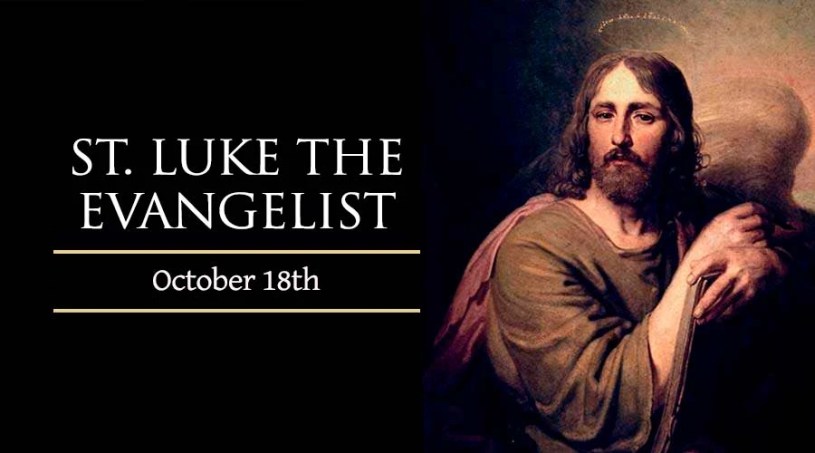
On 18 October the church remembers St Luke – one of the disciples of Jesus. St Luke is the patron saint of physicians, doctors, and surgeons. He is also the patron saint of notaries, because of his meticulous documentation in writing an orderly account of Jesus’ life and the early Church. He is further regarded as the patron saint of artists and painters, due to an Orthodox legend that he was the first icon maker. He is also the patron saint of butchers, as he is often symbolised by the emblem of a calf or ox, sometimes depicted with wings.
But who was St Luke, and what do we know about him?
Doctor Luke
The Early Christian Fathers wrote that Luke was a Gentile from Antioch, a doctor by profession, and a disciple of the apostles who later accompanied St Paul. Luke is called “the beloved physician,” or “doctor,” depending on your translation, and he brings greetings to the church at Colossae (Colossians 4:14). That the author of Luke’s Gospel was a doctor is perhaps suggested by the fact that the Gospel uniquely includes the proverb “Physician, heal thyself!” (Luke 4:23), and that in the parable of the Good Samaritan, Luke mentions the Samaritan tending the Jewish man’s wounds.
Luke the Gentile
The idea that Luke the Gentile is the author of the Gospel and Acts makes sense because Luke reads as if written from a Gentile rather than a Jewish perspective. Paul implies that Luke is not Jewish in Colossians 4:14 because he is not listed among those “men of the circumcision among my fellow workers” (Colossians 4:11) mentioned immediately before. The Book of Acts goes into great detail about the church at Antioch, as if written by someone from there, and it describes the conversion of St Paul as if written by someone who knew him.
Luke and Acts
Luke is not mentioned by name in either of his books, but both the Gospel of Luke and Acts are dedicated to the same person, Theophilus (Luke 1:3 and Acts 1:1). In the first verse of Acts, the author states that it follows a previous book about the teachings of Jesus (Acts 1:1). The connection between these two books is often lost on readers because they do not follow one another in the New Testament; the Gospel of John is placed between them in the traditional order.
Unique Stories in the Gospel of Luke
The writers of the four Gospel accounts were traditionally called “Evangelists,” and so Luke is often known as St Luke the Evangelist. Much of Luke’s Gospel closely resembles Mark and Matthew’s Gospels but includes additional material. One common theory is that Luke may have taken Mark’s Gospel and augmented it, as Matthew also did. His unique contributions seem to be accounts obtained from talking to eyewitnesses, as suggested in Luke 1:2.
It is only Luke who records parts of the Christmas story, such as the Annunciation to Mary, the birth of John the Baptist, the visit of the shepherds, and the story of Jesus’ childhood. These suggest that he had spoken to people in Jesus’s own family, perhaps even Mary herself.
Luke also includes some of Jesus’ most famous parables not found elsewhere, such as the Good Samaritan (Luke 10:25–37), the Prodigal Son (Luke 15:11–32), the Lost Coin (Luke 15:8–10), and the Rich Man and Lazarus (Luke 16:19–31), suggesting that he collected them from eyewitnesses or from early Christian tradition.
Luke alone records three of the sayings of Christ on the Cross: “Father, forgive them” (Luke 23:34), “Thou shalt be with me in Paradise” (Luke 23:43), and “Father, into thy hands I commend my spirit” (Luke 23:46). These suggest that he heard them from someone who was there—perhaps John, Mary, or even one of the Roman soldiers. Luke is also the only writer to include the story of the disciples on the road to Emmaus after Jesus’ resurrection (Luke 24:13–35), which suggests that he had met them and obtained the story directly.
The Book of Acts
Arguably, Luke is even more important as the author of the Acts of the Apostles. Commonly known simply as Acts, the book recounts the first three decades of the Early Church’s history. The story begins with the Ascension of Jesus (Acts 1:6–11), the apostles gathering in Jerusalem and waiting for forty days (Acts 1:12–14), the election of Matthias (Acts 1:15–26), the outpouring of the Holy Spirit at Pentecost (Acts 2), and then the growth of the Church, the story of Paul, and his missionary journeys.
In both Luke and Acts, the author does not use his own name, but he seems to include himself indirectly, as he often writes “we” to indicate that he was present with Paul. The sections written from this perspective are found in Acts 16:10–17, Acts 20:5–15, Acts 21:1–18, and Acts 27:1–28:16. Luke was with Paul in Rome (Acts 28:16), and near the end of Paul’s life he wrote that only Luke was with him (2 Timothy 4:11).
Luke makes many casual references throughout Acts to events, local customs, and practices, demonstrating a keen eye for detail and offering compelling evidence that he was there. The book of Acts ends in Rome, which suggests to many historians that it predates Nero’s persecutions and Paul’s death, helping to date the book to around AD 60.
It’s Worth Remembering …
Since the Early Church, it has been the tradition that Luke wrote both the Gospel of Luke and Acts of the Apostles, the latter being the follow-up book. St Luke’s Gospel is the only one with a sequel. The two books of Luke and Acts make up just over a quarter of the whole New Testament, meaning that Luke wrote more words of the New Testament than anyone else. Without him, we would not know some of the Christmas story, some of the most loved parables, nor the growth of the Early Church and Paul’s missionary journeys. He may have been responsible for even more of the New Testament, as he may have helped Paul to write his later letters—known as the Pastoral Epistles—particularly those to Timothy and Titus.
What Happened to Luke?
After the end of Acts, Luke disappears from the story. He is mentioned in Paul’s epistles, confirming that he travelled with Paul, but the New Testament does not tell us what happened to him afterwards. As is often the case, the gap in the biblical narrative is filled by ancient tradition. According to tradition, after the martyrdom of St Paul in AD 67, St Luke continued to preach throughout the Mediterranean. He is said to have lived a long life and was eventually martyred at the age of 84 in the Greek city of Thebes.
Tomb
The Church of Luke the Evangelist at Thebes was built around his tomb and relics, although it now only contains a rib. In AD 357 most of Luke’s remains were said to have been moved to the Church of the Holy Apostles in Constantinople by order of Emperor Constantine. They were reportedly moved for safety to Padua in northern Italy during the iconoclastic revolt, where they rest at the Basilica di Santa Giustina. In 1354, the skull was taken as a relic to Prague Cathedral. Confusingly, there is also a tomb reputed to be Luke’s in Ephesus. In any case, all of these places attract tourists and pilgrims in memory of St Luke.
A Prayer for St Luke’s Day
Almighty God, you called Luke the physician, whose praise is in the gospel, to be an evangelist and physician of the soul: by the grace of the Spirit and through the wholesome medicine of the gospel, give your Church the same love and power to heal; through Jesus Christ our Lord. Amen.
 revPACman