

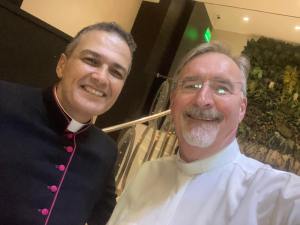
From 27-31 October 2025 I attended the Episcopal Diocese of Jerusalem Majma (Synod). On my Facebook page I posted how deeply moved I was by the resilience, faithfulness and perseverance shown by the colleagues and church members I met which leaves me humbled and full of admiration. I am reminded of the verse from Nehemiah 8:10 ‘The joy of the Lord is your strength.’ You can read a short review of my Majma experience on the website of the Anglican Diocese of Cyprus and the Gulf here.
The theme of the Majma was ‘Planning by the Spirit, Enlightened by Hope’ based on Ephesians 1:17-18. I come away with a greater understanding of what we mean when we use the word hope as Christians. Not hope in the western understanding where we hope things will get better sometime soon – where for many in this region it’s simply not the case – but hope in the New Testament sense which signifies a God-given certainty that is anchored in Jesus Christ and rooted in God’s promises. As Archbishop Hosam reminded us earlier in the week:
Hope helps us rise up after failure. Hope inspires us to plant, even if we do not see the harvest. Hope moves us to love, even amid hatred.
Reflecting on this theme, one of my highlights of the Majma was a Lament given by Venerable Imad Zoorob, Archdeacon in Lebanon. It was quite brilliant and heartfelt and something only someone from the region could write. I have Imad’s permission to post his words here. NB. Please note this has been translated into English from Arabic.
And He said to His disciples: “Therefore I tell you, do not worry about your life, what you will eat, nor about your body, what you will wear. Life is more than food, and the body more than clothing.” Matthew 6:25.
In a world dominated by resentment, exclusion, selfishness, and ego, where our homelands are battered by winds of deprivation, pain, and the loss of the very basics of a dignified life and the right to live, we recall the words of our Lord Jesus Christ: “I came that they may have life, and have it abundantly.” John 10:10.
Yes, we have reached a point where we lift our eyes toward heaven, sighing with groans of anguish and prayer, raising a lament soaked in reproach and crying out from hearts ablaze with pain: “Is this life? Is this the abundance You promised?”
We know and believe that You said to us: “In the world you will have tribulation, but take heart; I have overcome the world.” John 16:33. Therefore, as believers, we lift our daily prayers to the Father, saying: “Lead us not into temptation,” and if temptation comes, be, O Lord, always with us. Yes, our Father, we know that we will face hardships and trials, and inevitably, we will be tempted. As the saying goes: “The wise one is the one who saves himself.”
What our people have endured over the past years up to this very day gives the words “trial” and “tribulation” an entirely new dimension that transcends description and comprehension. And here arises the Church’s role—to be a pillar, a comfort, and a warm embrace kindled by the love of Christ. Yes—but how can we soothe the heart of someone whose life has been shattered by an overwhelming trial?
What can we say to an elderly man whose lifelong savings were stolen and whose house was destroyed by a senseless war? Instead of resting after a lifetime of toil, he now searches like a young man for his daily bread once more. How can we comfort him? Shall we say: “Do not worry about your life, what you will eat or drink”?
And that mother who sent her young children away, forced to part from them in pursuit of a better life! Or that mother who endures unbearable torment, longing just to see her daughter behind the bars of captivity and oppression! What can we say to them? “Do not worry about your body, what you will wear”?
And that man kneeling on the soil of Gaza, washing its bleeding earth with his tears, overwhelmed by horror, lost between dream and reality, bowing before the ruins of his home—now nothing but a handful of dust blown by the wind, and a white shroud covering the bodies of his children—what can we say to him? “Consider the lilies of the field”? Indeed, the land has become a field—but what lily are we speaking of? Is there even a green shoot left to take as an example?
Or what shall we say to a people whose only wish is to find a single grain of wheat—who dig through the soil with their hands, hoping to grasp some fallen crumbs as a luxurious meal? What can we say to the people of Gaza? “Look at the ravens”? Which ravens? The ravens of the cemeteries that have fled, unable to bear the stench of death?
Perhaps I should tell them about the old clay oven—the “tannour”—in the hope of stirring memories of family gatherings around the fire, as the grandmother blessedly shaped the dough with her gentle fingers to feed them from the warmth of her bread. Maybe that memory would bring them a faint smile to cool their hearts from the blazing fire of the hell they live in!
Forgive us, oh Lord, for we with a faithful heart do lift our hearts toward You, singing hymns and proclaiming: “Your word is a lamp to my feet and a light to my path.” Psalm 119:105. Indeed, the words of Christ, which adorn the pages of the Holy Scriptures—especially those in the Gospel of Luke the physician—are undoubtedly the light that guides us through the darkness of this age toward a better life. Yet our human minds—formed by the values of freedom, equality, and the right to life—can no longer comprehend the enormity of trials that strip away every spark of vitality, holding us accountable for every heartbeat that flows within us.
And in such moments, we may fall—even if only for a moment—under the heavy weight of numbness, spiritual disorientation, and loss of meaning. At that point, one either stops before the wall of weakness and surrender, or becomes like a sail moved by a divine breeze—a Pentecostal wind stirring the boat of one’s life toward hope and the dawn of a new day.
Nothing can restore consciousness, life, hope, and faith to a lost heart except the Holy Spirit—who blows where He wills—reviving the lifeless body and raising the fallen person once more, brushing off the dust of weakness and fate’s trials, lifting his eyes toward heaven with tears flowing down his cheeks, hoping they might find their way to his heart to cool its pain, and crying out with steadfast faith: “Thy will be done.”
Beloved, it is no coincidence that the theme of our blessed and honorable Council this year is taken from the lips of the Apostle Paul: “We plan with the Spirit… we are enlightened with hope.” It is not merely a slogan for the year, but rather a heavenly declaration—a roadmap adopted by our honorable Council, clergy and laity, leaders and workers alike—guided by the Holy Spirit and through the wisdom of a faithful captain and caring leader, entrusted with both shepherding and upholding the banner of Christ.
When trials come, the Spirit begins to work more deeply within the Church—in the diocese, in our Council entrusted with service—so that our planning may be inspired by the Spirit who neither slumbers nor sleeps. This spiritual interaction does not remain confined within the walls of the institution, but extends to touch the heart of the universal Church, where the Spirit of God stirs hearts of friends moved by the zeal of the Lord of Hosts. As His Beatitude said yesterday, recalling: “The Spirit unites us and makes us children of God.”
The Spirit moves the heart of a friend from Ireland to say: “God will not abandon us,” and another from America to say: “We are with you, you’re not alone, we see you.”
The Spirit moves through the hearts of the Diocese’s friends: American Friends, American Alliance, CMS, and many others, all united under one Spirit and in communion with the Anglican Communion, touching also the soil of Jordan and the heart of its gracious King.
In the light of the Spirit and of hope, planning becomes a prayerful act—an offering upon the Lord’s holy altar.
Brothers and sisters in Christ, when we gather to reflect on the future of our blessed Council, setting forth a roadmap drawn upon the waters of time, we remember the words of Saint Basil the Great: “The Holy Spirit is the architect of everything that is built within the Church.”
Therefore, from this perspective, we cannot plan except by the Spirit—for any project not founded upon listening to Him is like a house built upon sand. Yet the Spirit works only in a heart filled with hope—for only hope opens the horizon of vision. Just as the eye cannot see without light, so too the Church cannot see her path except in the light of hope.
With planning in the Spirit, we stand as faithful stewards, gazing toward the light of hope, joining His Beatitude in setting a clear vision that charts the course of service.
And as Reverend Bilal said, this not only brings joy to the heart and spiritual refreshment to our lives—it will surely lead us to witness a new Pentecost.
Let your plans, then, not be built on fragile sands that fear collapse, but like wings that embrace the wind.
For whoever plans in the Spirit does not ask about the way— he simply follows the radiant hope of heavenly light. Amen.
You may also find this meditation by Don Binder both meaningful and helpful.
Meditation: Don Binder
 revPACman