
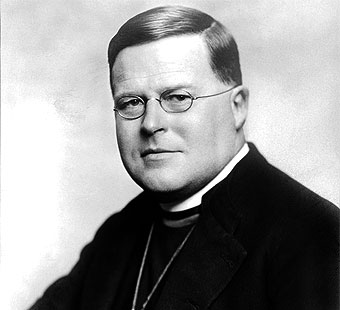
On 6 November the church remembers William Temple, teacher and preacher who served as Archbishop of Canterbury during the difficult days of the Second World War. His writings reflect a robust social theology that engaged the challenges of modern industrialized society.
But who was William Temple?
Temple was born on October 15, 1881. His father, Dr. Frederick Temple, Bishop of Exeter and then of London, became Archbishop of Canterbury when William was fifteen. Growing up at the heart of the Church of England, William’s love for it was deep and lifelong. Endowed with a brilliant mind, Temple took a first-class honours degree in classics and philosophy at Oxford, where he was then elected Fellow of Queen’s College. At the age of twenty-nine he became headmaster of Repton School, and then, in quick succession, rector of St. James’s Church, Piccadilly, Bishop of Manchester, and Archbishop of York.
Although he was never subject to poverty himself, he developed a passion for social justice which shaped his words and his actions. He owed this passion to a profound belief in the Incarnation. He wrote that in Jesus Christ God took flesh and dwelt among us, and, as a consequence, “the personality of every man and woman is sacred.”
A member of the Labour party (until becoming bishop) he was a convinced supporter of social and economic reform and served as the first president of the Workers’ Educational Association. Born to privilege himself, he sought to extend basic privileges to all, believing that ‘human status ought not to depend on the changing demands of the economic process’, and that ‘it is a mistake to suppose that God is only, or even chiefly, concerned with religion’.
In 1917, Temple resigned from St. James’s, Piccadilly, to devote his energies to the “Life and Liberty” movement for reform within the Church of England. Two years later, an Act of Parliament led to the setting up of the Church Assembly, which for the first time gave the laity a voice in church governance.
As bishop, and later as archbishop, Temple committed himself to seeking “the things which pertain to the Kingdom of God.” He understood the Incarnation as giving worth and meaning not only to individuals but to all of life. He therefore took the lead in establishing the Conference on Christian Politics, Economics, and Citizenship (COPEC), held in 1924.
In 1940, he convened the great Malvern Conference to reflect on the social reconstruction that would be needed in Britain once the Second World War was over. At the same time, he was a prolific writer on theological, ecumenical, and social topics, and his two-volume Readings in St. John’s Gospel, written in the early days of the war, rapidly became a spiritual classic.
In 1942, Temple was appointed Archbishop of Canterbury and reached an even wider audience through his wartime radio addresses and newspaper articles.
Temple left one of the classic definitions of Christian worship:
Worship is the submission of all our nature to God. It is the quickening of conscience by his holiness; the nourishment of mind with his truth; the purifying of imagination by his beauty; the opening of the heart to his love; the surrender of the will to his purpose – and all this gathered up in adoration, the most selfless emotion of which our nature is capable.
Temple famously stated, “The Church is the only society that exists for the benefit of those who are not its members,” highlighting his belief in the church’s role in serving others beyond its congregation. Another famous saying about the value of prayer, “When I pray, coincidences happen, and when I don’t they don’t.”
Like St Paul, Temple had a ‘thorn in the flesh’, throughout his life suffering from gout, which constantly caused him debilitating pain. His early death at the age of 63, on October 26, 1944, he died at Westgate-on-Sea, Kent, after only two and a half years at Canterbury and only eight months before the end of the Second World War, was a cruel blow, depriving both Church and nation of a wise and visionary leader at a time of national reconstruction and leaving a void that proved impossible to fill.
A Prayer
O God of light and love, you illumined your church through the witness of your servant William Temple: Inspire us, we pray, by his teaching and example, that we may rejoice with courage, confidence, and faith in the Word made flesh, and may be led to establish that city which has justice for its foundation and love for its law; through Jesus Christ, the light of the world, who lives and reigns with you and the Holy Spirit, one God, now and for ever. Amen.
Revd Paul A. Carr and extract from ‘Saints on Earth: A biographical companion to Common Worship’ by John H Darch and Stuart K Burns
 revPACman