
This is a copy of my talk given at Ayia Kyriaki and Saint Stephen’s in the Anglican Church of Paphos on Sunday 16 November 2025. The Lectionary Bible Reading was Luke 21:5-19.
Prayer
Heavenly Father,
I thank You for Your word.
By the power of Your Holy Spirit,
May You speak to my heart,
And change my life.
In the precious name of Jesus I pray.
Amen
Introduction
Two gas company servicemen, a senior training supervisor and a young trainee, were out checking meters in a suburban neighbourhood. They parked their van at one end of the road and worked their way to the other end. At the last house a woman looking out her kitchen window watched the two men as they checked her gas meter.
After they finished checking the meter, the supervisor challenged his trainee to a race back to the van to prove that an older guy could outrun a younger one. As they came running up to the van, they realized the lady from the last house was huffing and puffing right behind them. They stopped and asked her what was wrong. Gasping for breath, she replied: “When I see two gas men running as hard as you two were, I figured I’d better run too!”
1. The Temple And Its Destruction
This story, and our Gospel reading from Luke, are both examples of the old adage that ‘things are not always what they seem.’ When Jesus overheard people marvelling at the beauty of the Temple He said to them, “As for these things which you see, the days will come, in which there will not be left here one stone on another that will not be thrown down.” (Luke 21:6)
You can imagine their shock. The Temple was about one hundred feet high and fifteen hundred feet wide. Some of the stones weighed up to one hundred tons each. Imagine standing in front of St. Peter’s Basilica in Rome, or the Taj Mahal in Agra, India and you get a better picture of its size and splendour. But it wasn’t only huge, it was ornate, too. The Jewish historian, Josephus, said that the outer structure of the Temple was covered with gold plates so that when the sun came up:
It radiated so fiery a flash that persons straining to look at it were compelled to avert their eyes, as from the solar rays.
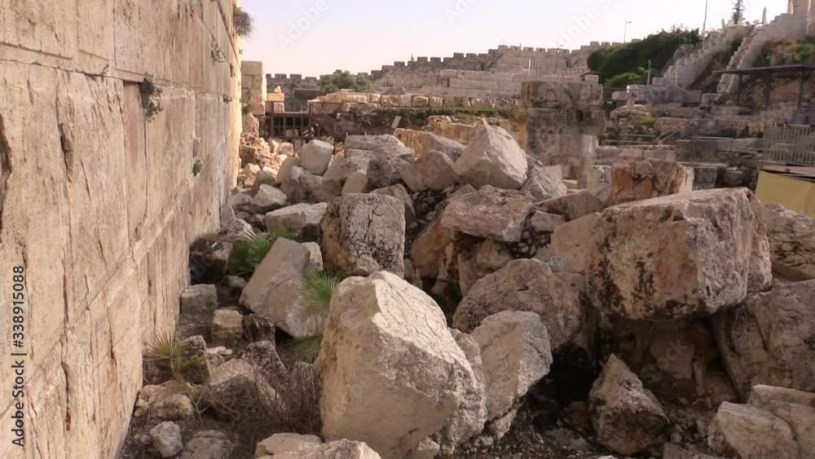
And it was just as opulent on the inside, as the outside. The Jews put too much emphasis on the Temple. And in doing so they allowed its magnificence to overshadow the majesty of God. However, all that changed in 70 AD when the Romans destroyed the Temple and levelled the city of Jerusalem to a pile of rubble. The effect was both devastating and demoralizing. From that point onwards, they would worship wherever they could – in homes or small make-shift synagogues, and their temples might not be anything more than a table, a menorah and a copy of the Torah, if they were lucky enough to have one.
Yet, over time, this had a positive effect. The simplicity and smaller scale made the worship setting more intimate and personal and brought them closer to God. They were scattered to the four winds, known as the diaspora, and they would be without a homeland for nineteen hundred years.
That is until, in 1947, when the United Nations partitioned a small sliver of land in the Middle East to create the nation of Israel. They survived. If anything, they grew stronger and more resilient. And that’s what I want us to think about this morning: how, so often, out of the rubble of tragedy new life springs forth, more abundant than ever.
2. Hope Rooted In Jesus Christ And God’s Promises
As you know I represented Bishop Sean at the Diocese of Jerusalem Majma (Synod) in Jordan from 27-31 October. I can’t tell you how deeply moved I was by the resilience, faithfulness and perseverance shown by the colleagues and church members I met which leaves me humbled and full of admiration.
The American author Sheldon Vanauken said that the strongest case for (and also against) Christianity isn’t its preaching or its books, but its people. He wrote:
The best argument for Christianity is Christians: their joy, their certainty, their completeness … There are impressive indications that the positive quality of joy is in Christianity – and possibly nowhere else.
Because the Church is full of human beings, it’s also full of death and dementia and divorce. These things come to us, just as they come to all humankind. But we face them with great hope, anticipating, as the Creed reminds us, the resurrection of the dead and the life of the world to come.
3. Things Are Not Always What They Seem
When the disciples saw Herod’s temple, they saw its external beauty, but they failed to see what lay behind it: spiritual bankruptcy, hypocrisy, oppression, rejection of Jesus and his teaching about the Kingdom of God, and Jesus’ impending death at the hands of the religious authorities. That’s why Jesus warned the disciples to beware of the false teachers who would come and proclaim they were the promised Messiah. He knew, just as the temple’s beauty hid its ugly secrets, the false teachers with their appearances, methods and teachings would hide their true motives.
But not all false prophets are religious. Some of them promote get-rich-quick schemes and preach a gospel of stocks, bonds and shares. Unfortunately, there are all kinds of schemers out there, especially those who will prey on the elderly and the less fortunate in society.
4. An Uncertain Future
Jesus doesn’t promise us a rose garden here on earth. In fact, he makes it quite clear to his disciples, and us, that people will hate them and persecute them. He doesn’t tell the disciples that they will escape pain, and he doesn’t tell us that either. The Church in many parts of the world lives with wars, rumours of wars, purges and persecutions on a daily basis.
Many Christians in our world regularly face imprisonment, threats, harassment, beatings and even death for their faith. Suffering is the one experience guaranteed to every Christian: “In this world you will have trouble” (John 16:33). Jesus says that those who do His work in the world can expect to face persecution, but He promises that the persecutions his followers will face will give them opportunities to witness to the Gospel.
We in the western world do not face these extremes, but we still face the prospect of rejection, job loss or discrimination because of our faith. Today’s Martyr’s will testify that God is faithful to his promises, providing words, wisdom and above all perseverance. In trial God will give us the strength to face adversity and persecution. He will tell us what to do, say and even think, just like he promised the disciples that he will tell them what to do, say and think.
For example, Paul and Silas, when imprisoned, sang hymns (Acts 16:25). Stephen, when martyred, forgave his attackers (7:60). And Peter, writing to the earliest Christians, urged them to “rejoice insofar as [they] share Christ’s sufferings” (1 Pet. 4:13). Christians don’t “grieve as others do who have no hope” (1 Thess. 4:13). Our grief is a hopeful grief. And the gospel gives Christians a deep resilience in the midst of suffering.
5. Upside Down And Inside Out!
It’s worth bearing in mind that these words in Luke are specifically about the fall of Jerusalem not the end of the world. However, it may be taken as a window that peers into an uncertain future, encouraging us to trust in God when everything is crashing down around us. It’s interesting that in Paphos this past week we’ve had Torrential Rain, High Winds, Thunderbolts and Lightning (very, very, frightening?) Hail and Earthquakes (When I was in Theatre just about to have my cataract operation – that was frightening!). I’m just waiting for Rivers of Blood and pestilence!
In closing, the theme of the Jerusalem Majma was ‘Planning by the Spirit, Enlightened by Hope’ based on Ephesians 1:17-18. One of my highlights of the Majma was a Lament given by Venerable Imad Zoorob, Archdeacon in Lebanon. It was quite brilliant and heartfelt and something only someone from the region could write. It’s on my website – you really should read it. I want to finish with a quote from it:
Forgive us, oh Lord, for we with a faithful heart do lift our hearts toward You, singing hymns and proclaiming: “Your word is a lamp to my feet and a light to my path.” Psalm 119:105. Indeed, the words of Christ, which adorn the pages of the Holy Scriptures – especially those in the Gospel of Luke the physician—are undoubtedly the light that guides us through the darkness of this age toward a better life. Yet our human minds – formed by the values of freedom, equality, and the right to life – can no longer comprehend the enormity of trials that strip away every spark of vitality, holding us accountable for every heartbeat that flows within us.
And in such moments, we may fall – even if only for a moment—under the heavy weight of numbness, spiritual disorientation, and loss of meaning. At that point, one either stops before the wall of weakness and surrender or becomes like a sail moved by a divine breeze – a Pentecostal wind stirring the boat of one’s life toward hope and the dawn of a new day.
As the few verses from Malachi remind us, the God who made and loves the world will, at the last, put all wrongs to right and this is what we cling to in a world where everything seems upside down and inside out.
I came away from the Majma with a greater understanding of what we mean when we use the word hope as Christians. Not hope in the western understanding where we hope things will get better sometime soon – where for many in this region it’s simply not the case – but hope in the New Testament sense which signifies a God-given certainty that is anchored in Jesus Christ and rooted in God’s promises. As Archbishop Hosam reminded us:
Hope helps us rise up after failure. Hope inspires us to plant, even if we do not see the harvest. Hope moves us to love, even amid hatred.
As I suggested earlier: Out of the rubble of tragedy new life springs forth, more abundant than ever. Amen.
COPYRIGHT DISCLAIMER The text contained in this sermon (except where stated) is solely owned by its author, Revd Paul A. Carr. The reproduction, or distribution of this message, or any portion of it, should include the author’s name.
 revPACman