
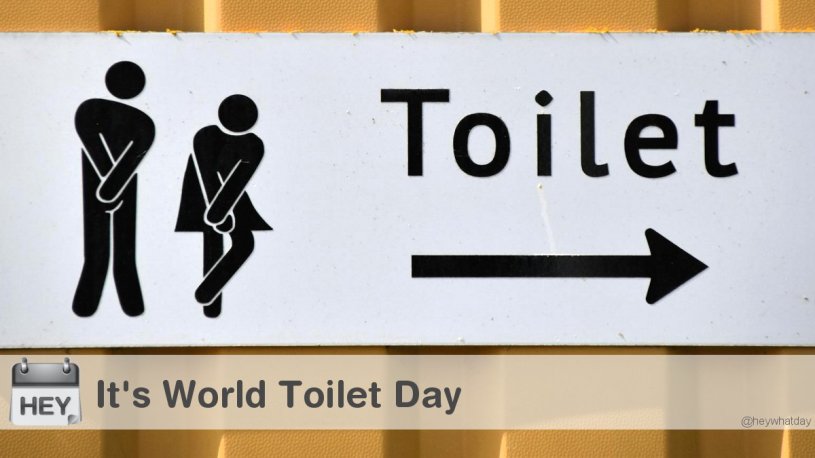
Who knew there was such a thing! But apparently it’s celebrated on 19 November.
An Ode to the Throne
Today, we celebrate the humble toilet — the unsung hero of daily life.
You may not enjoy pondering the inner workings of a good clear-out…
but let’s be honest — when everything goes smoothly,
it’s one of life’s quiet victories.
A moment of peace.
A little sit-down that resets the soul.
From the ancient chamber pots to the porcelain thrones of today,
humanity has come a long way –
and so has our appreciation for comfort, cleanliness, and blessed privacy!So here’s to:
The flush that never fails
The seat that’s just the right temperature
The door lock that actually works
And the glorious invention that keeps our homes smelling like homesLet’s give a royal nod to the greatest invention we never dare talk about …
The Throne that keeps civilisation moving!
Happy World Toilet Day – may your flush be strong,
your queue be short, and your peace be uninterrupted.
It is a widely-held belief that Thomas Crapper designed the first flush toilet in the 1860s. It was actually 300 years earlier, during the 16th century, that Europe discovered modern sanitation.
The credit for inventing the flush toilet goes to Sir John Harrington, godson of Elizabeth I, who invented a water closet with a raised cistern and a small downpipe through which water ran to flush the waste in 1592. He built one for himself and one for his godmother; sadly, his invention was ignored for almost 200 years: it was was not until 1775 that Alexander Cummings, a watchmaker, developed the S-shaped pipe under the toilet basin to keep out the foul odours.
As the population of Britain increased during the 19th century, the number of toilets did not match this expansion. In overcrowded cities, such as London and Manchester, up to 100 people might share a single toilet. Sewage, therefore, spilled into the streets and the rivers.
This found its way back into the drinking water supply (which was brown when it came out of the pipes) and was further polluted by chemicals, horse manure and dead animals; as a result, tens of thousands died of water-borne disease, especially during the cholera outbreaks of the 1830s and 1850s.
In 1848, the government decreed that every new house should have a water-closet (WC) or ash-pit privy. “Night soil men” were engaged to empty the ash pits. However, after a particularly hot summer in 1858, when rotting sewage resulted in “the great stink (pictured right in a cartoon of the day)“, the government commissioned the building of a system of sewers in London; construction was completed in 1865. At last, deaths from cholera, typhoid and other waterborne diseases dropped spectacularly.
He patented a number of toilet-related inventions but did not actually invent the modern toilet, although he was the first to display his wares in a showroom. He and his contemporaries, George Jennings, Thomas Twyford, Edward Johns & Henry Doulton, began producing toilets much as we know them today.
 revPACman