
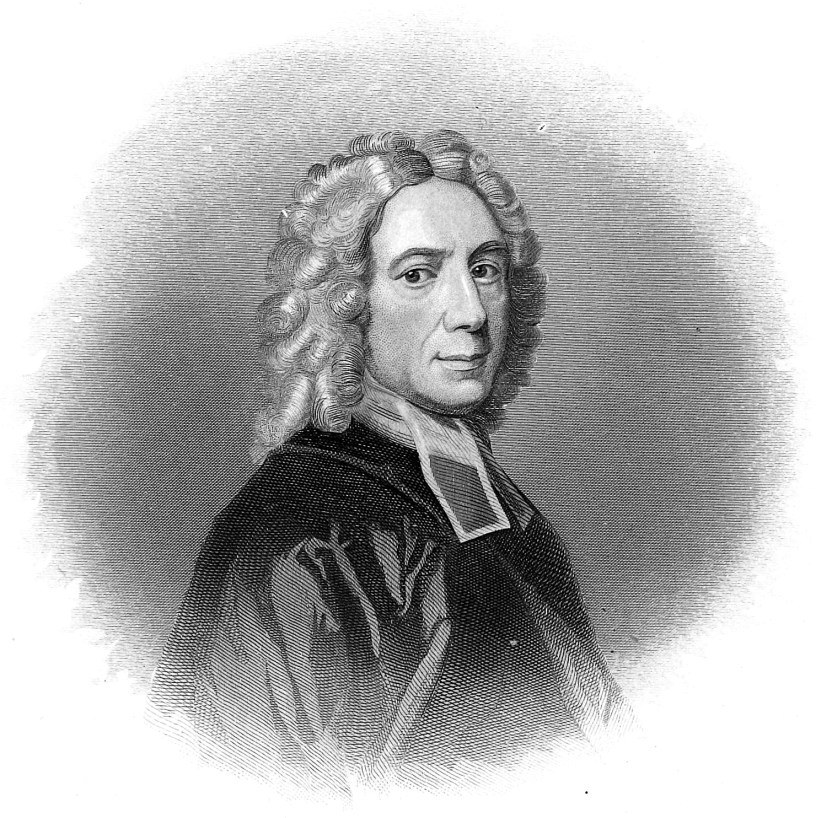
On 25 November, the church remembers Isaac Watts, hymn writer.
But who was Isaac Watts?
Isaac Watts was born in Southampton in 1674 and educated at the grammar school there. Having considerable academic ability he came to the attention of a local benefactor who offered to send him to university.
But rather than Anglican Oxford or Cambridge Watts chose the highly regarded Dissenting Academy at Stoke Newington in Middlesex. Leaving there in 1694 he worked first as a private tutor before entering the Independent ministry, first as assistant in 1699, then three years later as pastor of Mark Lane Chapel in London.
Because of deteriorating health he resigned his ministry at Mark Lane in 1712 and retired to Abney Park, Stoke Newington, where for the remaining 36 years of his life he lived under the patronage of the Abney family. Here his limited financial independence allowed him the freedom to write and yet he was said to have given away to the poor a third of his modest allowance.
Watts has sometimes been accused of harbouring Unitarian sympathies but this was probably an inaccurate inference from his known opposition to a proposal in 1719 to require Nonconformist ministers to subscribe to the doctrine of the Trinity. It would appear to have been the proposed compulsion rather than the doctrine itself that he opposed.
Physically unprepossessing, it was his serene and spiritual manner and his unswerving faith that endeared him to others and is reflected in the words of many of his hymns. In fact he wrote over six hundred hymns though few of these are now in regular use. Among his hymns still sung are Jesus shall reign where’er the sun, Joy to the world and, one of the finest English hymns of any age, When I survey the wondrous cross.
Known as the father of English hymn writing, Watts both continued in the tradition of metrical Psalms (e.g. Psalm 90 – O God, our help in ages past) and began a general move away from that rather limited musical diet to a richer variety of hymnody that took root in both Nonconformity and the Church of England.
Whilst this move was both immensely popular and controversial to church authorities, he defended himself by quoting St. Paul, who recommended singing “psalms, hymns and spiritual songs.” His hymns largely focus on individual emotional experience, rather than a shared response of the Christian community.
See from His head, His hands, His feet,
Sorrow and love flow mingled down:
When did such love and sorrow meet,
Or thorns compose so rich a crown?
Were the whole realm of nature mine,
That were an offering far too small;
Love so amazing, so divine,
Demands my soul, my life, my all!
A Prayer
God of truth and grace, you gave Isaac Watts singular gifts to present your praise in verse, that he might write psalms, hymns and spiritual songs for your Church: Give us grace joyfully to sing your praises now and in the life to come; through Jesus Christ our Saviour, who lives and reigns with you and the Holy Spirit, one God, for ever and ever. Amen.
Revd Paul A. Carr and extract from Saints on Earth: A biographical companion to Common Worship by John H Darch and Stuart K Burns
 revPACman