
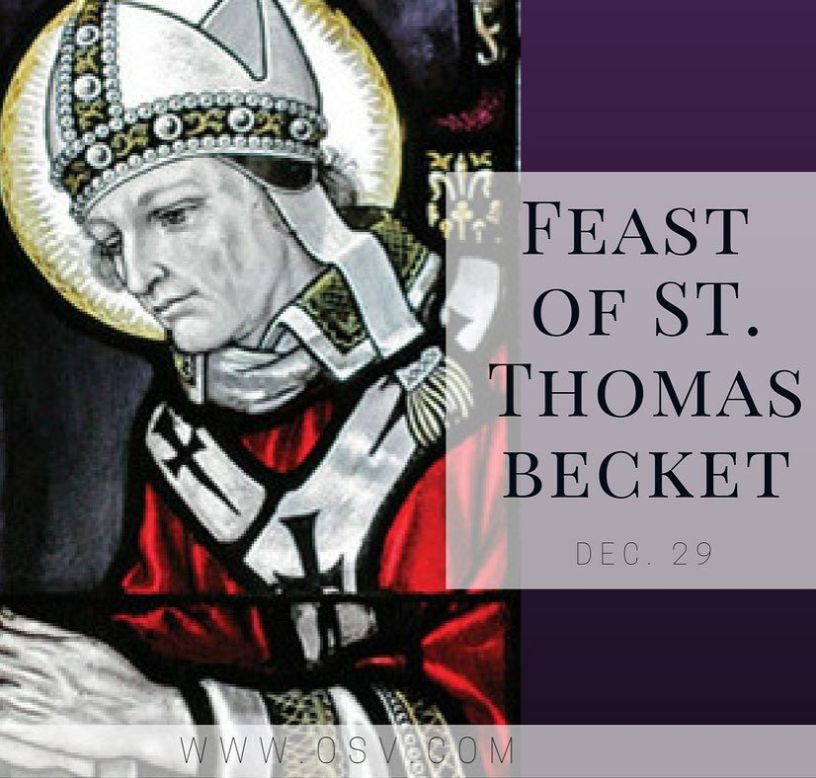
Today the Church remembers Thomas Becket, archbishop, martyr, 1170.
But who was Thomas Beckett?
Born in London around 1118, the son of a wealthy Norman merchant, Becket was educated at Merton Priory in Surrey and later in Paris. About 1141 he entered the household of the Archbishop of Canterbury, Theobald of Bec, who sent him to Bologna to study law and on his return in 1154 ordained him and appointed him Archdeacon of Canterbury.
In the Middle Ages it was the Church, with a virtual monopoly on the supply of educated men, who provided the officials to administer the king’s government. The new King Henry II needed a Chancellor (in effect his principal minister) and on the recommendation of Theolbald, who hoped that he would look after the Church’s interests, Becket was appointed Chancellor in 1155. The next eight years he spent in unstinting service to the king and the two apparently became close personal friends.
Thus in 1161 when Archbishop Theolbald died, Henry, no doubt hoping to bring the Church more firmly under his control, appointed Becket as archbishop in his place. But Henry had miscalculated. Immediately after his consecration in 1162 Becket resigned the Chancellorship, turned away from the luxuries of court to an austere lifestyle and ‘from being the king’s dutiful minister he became the uncompromising champion of the church’.
Good working relations between Henry and Becket soon evaporated as misunderstandings developed and conflict came to a head over the 1164 Constitutions of Clarendon, the king’s attempt to extend the legal jurisdiction of his courts over clergy as well as lay people and to forbid their right of appeal to Rome. Becket saw this as a crude attack on the Church’s ancient privileges and his relationship with the king deteriorated into outright hostility, as a result of which he fled to France.
Eventually, under threat of papal sanctions, a reconciliation was patched up and Becket returned to England in November 1170. But when he excommunicated some of the bishops and barons who had supported the king, Henry flew into a rage and called for the removal of ‘this turbulent priest’. Four knights, who interpreted this as a coded instruction to action, made their way to Canterbury and murdered Becket before the high altar of the cathedral on 29 December 1170.
Becket was canonized less than three years after his murder and Henry was obliged to do public penance at his tomb, which became a place of popular pilgrimage throughout the Middle Ages.
Prayer
Lord God,
who gave grace to your servant Thomas Becket
to put aside all earthly fear and be faithful even to death:
grant that we, disregarding worldly esteem,
may fight all wrong,
uphold your rule,
and serve you to our life’s end;
through Jesus Christ your Son our Lord,
who is alive and reigns with you,
in the unity of the Holy Spirit,
one God, now and for ever.
Amen.
Extract from Saints on Earth: A biographical companion to Common Worship by John H Darch and Stuart K Burns
 revPACman