
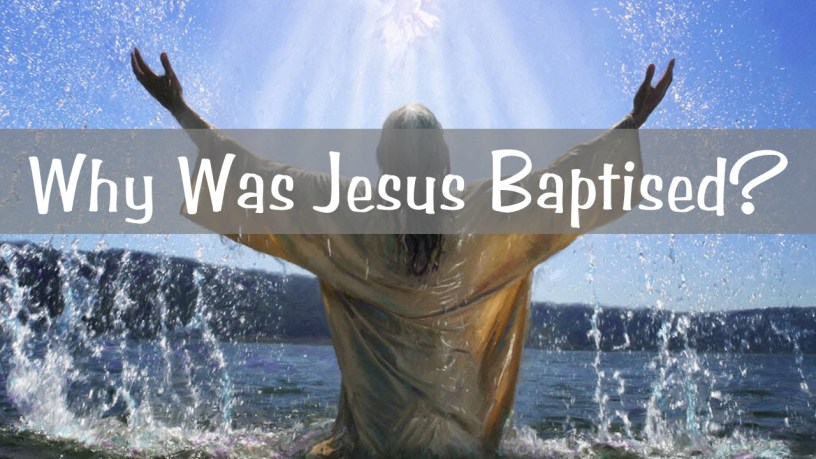
This is a copy of my talk given at Ayia Kyriaki and Saint Luke’s in the Anglican Church of Paphos on Sunday 11 January 2026. The Lectionary Bible Reading was Matthew 3:13-17
Prayer
Heavenly Father,
I thank You for Your word.
By the power of Your Holy Spirit,
May You speak to my heart,
And change my life.
In the precious name of Jesus I pray.
Amen
Introduction
There are days in our life that are of great importance. A tombstone usually lists a person’s date of birth and death. The next most commonly recorded date for a person is their marriage. And then you’ll find a person’s date of baptism. You could say that your date of baptism is the 4th most common recorded date. It is the day in which the sign and seal of God’s covenant of Grace was administered to you.
Another important day (though seldom recorded for posterity) is the day you begin your career or were commissioned to your work. Many jobs, of course, don’t have a formal commission. But some do. I was commissioned in Her Majesty’s Prison Service on 28 March 1987. Armed Forces and the Police have something similar. I was ordained on the 29 June 1997 (I will have been ordained 30 years this year – I can’t believe it!) and Installed as Archdeacon in Cyprus on 24 May 2025.
Many people are commissioned to their work, or given the approval of a higher authority – whether they are selected or voted in. In Matthew’s Gospel Jesus has his baptism and commissioning combined into one. Here Jesus is Baptised and then he is Anointed to His calling as the promised Messiah.
Jesus is now on the scene as an adult for the first time. Jesus, like his cousin John, is about 30 years old (Luke 3:23). This delay in each starting their ministries may be related to the OT priesthood requirement in Numbers 4:30 that a priest must be 30 years old. Jesus is now ready to go unto the world. His days of carpentry have passed. His preaching is about to begin.
Why was Jesus Baptised?
Vs13: “… Jesus came from Galilee to the Jordan to be baptized by John. But John tried to deter him, saying: I need to be baptized by you, and do you come to me?” At its simplest, Jesus is saying that in being baptised he is doing what pleases God. He is fulfilling the plan of God. In Jesus’ day, baptism was a religious ritual that non-Jews went through when they wanted to convert. They would wash themselves with water and confess their sins publicly.
It was a ritual for moral and religious outcasts. John had taken up this ritual and used it to prepare people for the coming of the Messiah. And the reason was the same. They confessed their sins and showed they were willing to prepare for the coming of the promised King.
The washing of water outwardly symbolised an inner washing of the heart. As the people confessed their sins, so they were forgiven, and baptism was the outward symbol of that inner cleansing. So, baptism was a humbling experience. You had publicly to confess your sin, to show you were not good enough for God, and that you needed his forgiveness and mercy. It was a big visual aid of helplessness and a cry for mercy.
You can see why John was so surprised to see Jesus coming for baptism, can’t you? Because the one thing Jesus did not need was forgiveness and to confess his sins. Why? Because he was sinless! He didn’t need forgiveness because he hadn’t sinned! And John knew that. He was Jesus’ cousin. He’d have known the extraordinary story of Jesus? birth and his childhood.
John tries to deter him. “I need to be baptised by you.” I’m the one that needs the forgiveness, not you. If anyone’s going to be doing any baptising, it should be you. It would be like David Beckham coming to me and asking for tips on how to play football. I’m sure I could teach him a thing or two about Rugby, sermons, and plenty of other things – but I can’t teach him anything about football! He needs to teach me. And that’s John’s feeling here about Jesus: “I need to be baptized by you … and you come to me?”
So why does Jesus undergo baptism? Why submit himself to a ritual for religious and moral outcasts. There are multiple reasons for Jesus’s baptism, but I want to suggest four to you this morning:
1. Jesus was Baptised: To Fulfill All Righteousness
Vs15: “Jesus replied, Let it be so now; it is proper for us to do this to fulfil all righteousness. Then John consented.” And that word fulfil is significant for Matthew. He’s already used it several times in his Gospel. And by it he means that Jesus is the fulfilment of the promises in the OT.
So, when Jesus says he is fulfilling all righteousness, he’s saying more than simply doing God’s will. He’s saying that he is bringing to completion all the promises of the OT. And in Jesus’ baptism we see two prophecies from the Psalms and Isaiah fulfilled in vs17: “And a voice from heaven said, “This is my Son, whom I love; with him I am well pleased?”
When God declares “this is my Son” he is not patting Jesus on the back and saying, “Well done Son. Keep up the good work.” No, this voice is for our benefit. He’s leaving us in no doubt as to who this Jesus is. This is a direct quote from Psalm 2:7 – and every Jew accepted that particular Psalm as a description of the Messiah.
2. Jesus was Baptised: To Identify With Us
Jesus is saying: “I am identifying myself with you. I am one of you. I am walking where you walked and stepping into your shoes.” It’s not that Jesus needs forgiveness or baptism. Rather he is showing us that he stands with us. RC Sproul: “Even though Jesus had no need for baptism, he submitted to this rite as part of His corporate solidarity with His people.”
This is a definite benefit of Jesus’ baptism; so that we share that same experience. Another commentator says, “Jesus, by submitting to baptism, identifies with humanity’s need for cleansing” (Bock). So, Jesus identifies with His people who are also called to baptism.
3. Jesus was Baptised: To Be Anointed In His Ministry
This is the beginning of his career. He needs a commissioning, and this is it. He is being identified by God as the Messiah – prophet, priest and king. And he is approved of by God the Father and by the Holy Spirit. This matches what we’ve been seeing in these first chapters of Matthew.
The genealogy said it, the place of birth said it, the prophets Micah and Isaiah said it, the shepherds said it, the wise men said now God the Father and the Holy Spirit put their stamp of approval on Jesus with a divine endorsement. God speaks from heaven to approve Jesus, and the Holy Spirit comes upon Christ anointing him.
3:16-17: And when Jesus was baptized, immediately he went up from the water, and behold, the heavens were opened to him, and he saw the Spirit of God descending like a dove and coming to rest on him; and behold, a voice from heaven said, “This is my beloved Son, with whom I am well pleased.”
And this is a quotation from Isaiah 42, in which the suffering Servant is being described; the suffering Servant who carries the sins of the world. And Jesus, of course, was that suffering Servant who carried the weight of our pains and sins and wrongdoings so that we could be put right with God.
And in those words from Matthew 3:16-17, we have Biblical proof of the Trinity. The Son, Father and Holy Spirit present in one place. And now this Spirit of God, this Holy Spirit, alights on Jesus in his baptism as the assurance of God’s presence with him, empowering him for the ministry that lies ahead. It was this Holy Spirit that empowered Jesus to heal the sick and calm the storms and turn water into wine, and raise the dead, and multiply loaves and fishes.
The Father’s words refer to Jesus in a uniquely literal way, but they also apply to each one of us. By God’s grace, we are his beloved sons and daughters. In our baptism we leave behind our old identity, we are identified and claimed by God as his children. A reminder for us to look to our baptisms and to the work that is set out in front of us; whatever we are called to do.
4. Jesus was Baptised: To Provide An Example
Another reason why Jesus was baptized, was to provide an example for us. This one is so simple that we might easily overlook it. He was baptized. We are called to do the same. Like Jesus, we receive the mandate to serve others through our baptism. Remember the great commission in Matthew 28: Make disciples of all nations, baptising them in the name of the Father, Son, and Holy Spirit.
Each one of us, through our baptism, is called into a life of service: we are brought into the Body of Christ, the church, through our baptism, and the church is a servant community. We are to serve those around us – friends, family, other members of the local community and do what we can to meet their needs in good times and in bad.
And so, on this Sunday when we remember the baptism of Christ, we give thanks to God for our own baptisms and we recommit ourselves to living out those baptismal vows; to live faithfully as God’s children, in the power of the Holy Spirit and in the service of those in our community and the wider world.
COPYRIGHT DISCLAIMER The text contained in this sermon (except where stated) is solely owned by its author, Revd Paul A. Carr. The reproduction, or distribution of this message, or any portion of it, should include the author’s name.
 revPACman