
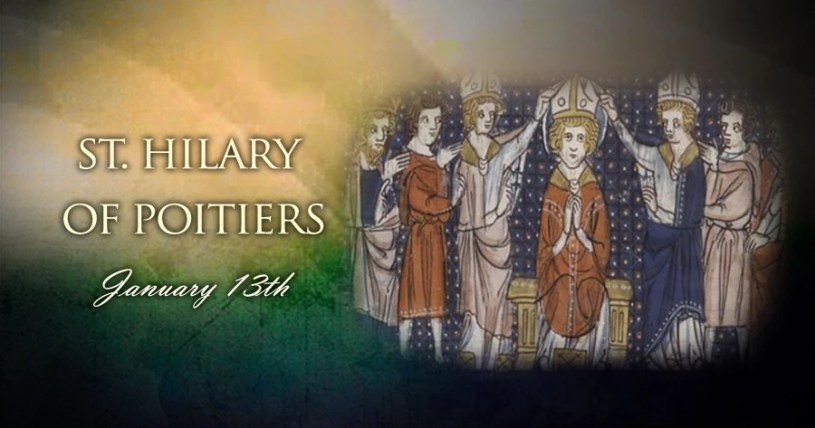
On 13 January the church remembers Hilary, bishop, teacher of the faith, (born c.315, Poiters, Gaul (France), died c.367. was a champion of orthodoxy against the heretical doctrine of Arianism. He is venerated as a Patron Saint of lawyers, mothers, children and sick people.
But who was Saint Hilary?
Hilary became a Christian only after a prolonged period of study and enquiry. Initially an Orator, born of pagan parents, Hilary became disenchanted with pagan philosophy and started to investigate Christianity. He became a staunch defender of orthodoxy against Arianism, which denied the full divinity of Christ. He was made a bishop in 350.
As a bishop, Hilary was influential and vocal in theological debate, and many in the Western Church considered him to be a mischief maker and one who spread discord. Much of his reputation rests on his activity in councils and debates.
On account of his teaching on the divinity of the Son, the Emperor Constantinus, an Arian sympathizer, had him excommunicated in 353. He was exiled to Phrygia in Asia Minor, albeit with freedom of travel. This resulted in him having the opportunity to encounter many Greek Christian theological writings for the first time, especially those of Origen, and this period saw him develop his theological understanding, strengthen his anti-Arian stance, and deepen his spirituality.
While in Phrygia, he wrote De trinitate (The Trinity), the first work in Latin to deal with the issues of the Trinitarian controversies. In De synodis (“Concerning the Synods”) he explained the history of the Arian controversy and directed the faithful in the East to rally against those who believed the Son was unlike the Father.
Hilary took part in the Council of Seleucia in 359, unsuccessfully campaigning against Arianism. In 360 he returned from exile to Gaul and was welcomed with great rejoicing, although he was not reinstated as bishop. He brought an orthodox theological understanding to the West, and was moderate in both discipline and doctrine, persuading many Western bishops of the validity of Eastern theology. He spent his last years in Gaul writing his commentary on the Psalms and Tractatus mysteriorum on typology. His reaffirmation of orthodoxy, almost alone in Gaul, earned him the title of the Athanasius of the West as a defender of faith and a campaigner against Arianism.
Hilary wrote many doctrinal and historical works, and also hymns. He is the first known writer of hymns in the Western Church, which before him sang only songs from a scriptural source. Hilary was impressed by the Eastern use of song as a means of spreading orthodox doctrine, and on his return to the West introduced such hymns to Western Christianity.
Unsurprisingly Hilary’s hymns develop Trinitarian themes and stress the relation of Christ to the Father. However, some of them are so intricate and precise in their theology that they were said to be difficult to sing!
Hilary, to the Bishops of Gaul, Germany and Britain: Oh you happy and glorious ones in the Lord, you who keep your confession of the perfect apostolic faith in your hearts and until now knew nothing of any written creeds! You did not need the letter because you were overflowing with the Spirit. Nor did you desire to use your hands for writing because for your salvation you confessed with your mouths and believed in your hearts.
Hilary was declared a doctor of the church in 1851 by Pope Pius IX.
A Prayer
Everlasting God,
whose servant Hilary
steadfastly confessed your Son Jesus Christ to be both human and divine:
grant us his gentle courtesy
to bring to all the message of redemption in the incarnate Christ,
who is alive and reigns with you,
in the unity of the Holy Spirit,
one God, now and for ever.
Amen.
Revd Paul A. Carr and extract from Saints on Earth: A biographical companion to Common Worship by John H Darch and Stuart K Burns
 revPACman