
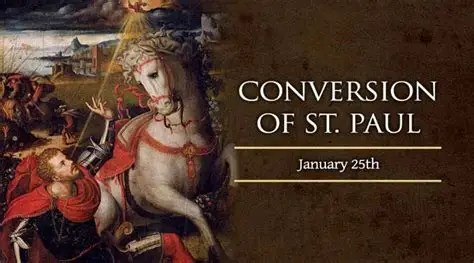
This is a copy of my talk given at Ayia Kyriaki and Saint Luke’s in the Anglican Church of Paphos on Sunday 25 January 2026. The Lectionary Bible Reading was Acts 9:1-22
Prayer
Heavenly Father,
I thank You for Your word.
By the power of Your Holy Spirit,
May You speak to my heart,
And change my life.
In the precious name of Jesus I pray.
Amen
Introduction
On Sunday 25 January the Church calendar remembers when I became a Christian 40 years ago. There can’t be many of us who have a date set aside just for them! I wish it were true, but it’s certainly a day when we remember the amazing conversion of the Apostle Paul and the impact he had on the growth of the early Christian church.
Persecutor of the Church
Of course, we know that Saul/Paul, at one time, was a religious extremist who very gladly saw to the violent and bloody death of Stephen. In Acts 8:3, we read: ‘Saul began to destroy the church. Going from house to house, he dragged off men and women and put them in prison.’ Saul hated Christians and he did his very best to destroy the fledgling Christian Church.
Persecution is not a thing of the past. There are many religious zealots, Atheists and Humanists today who hate Christian believers and want to destroy the Church – just like the young man Saul. Persecution is very much part of being a Christian if you live in Iran or Syria or Nigeria, where 1000’s of Christians have been killed because of their faith or because they are not willing to renounce Jesus as Lord and Saviour. How grateful we should be to be able to worship openly and without fear of death.
When you’re not sure how to pray for modern day religious zealots, turn to the last verse of Acts, 28:31, which concludes with these words: “Boldly and without hindrance [Paul] preached the kingdom of God and taught about the Lord Jesus Christ.” Pray that those words will become true for them. Pray for their conversion, and that they will become bold evangelists for Jesus.
A Hebrews of Hebrews
At the time of our Bible reading Paul was young, zealous and studious (Acts 7:58). He knew the Hebrew Scriptures inside out. He had all the qualifications people looked for to be identified as one of God’s people. He had all of the boxes ticked, and later wrote about himself that he was: ‘…circumcised on the eighth day, of the people of Israel, of the tribe of Benjamin, a Hebrew of Hebrews; in regard to the law a Pharisee; … as for legalistic righteousness, faultless’ (Philippians 3: 5-6). In other words, Saul had been a member of the religious community since birth.
It would be like a young man today who was Baptised as a baby, brought up in the church, taught the Bible at Sunday school, being part of a Youth Group, strictly applying the 10 commandments, becoming a member of General Synod and becoming a household name, whilst at the same time seeking to silence or dumb-down the message of Jesus.
The Damascus Road Experience
Acts 9:1: Saul continued to ‘[breath] out murderous threats against the Lord’s disciples.’ He was given permission to arrest believers in the synagogues of Damascus; but ‘as he neared Damascus on his journey, suddenly a light from heaven flashed around him. He fell to the ground and heard a voice say to him, “Saul, Saul, why do you persecute me?”’ (9:3-4). “Who are you, Lord?” Saul asked. “I am Jesus whom you are persecuting” He replied. “Now get up and go into the city and you will be told what you must do” (9:5-6).
Paul saw the light of Christ even before he lost his physical sight. Paul had to lose his physical sight and be humbled by God so that he could gain spiritual sight. During his period of blindness, he ate and drank nothing. Was it because he was ashamed of his previous life? Maybe, but some scholars believe that he was preparing himself for the work God called him to do. Some of us only need a gentle nudge to lead us to God, while others need a lightning bolt.
Paul realized that he was lost. He realized that by persecuting Christians, he was actually persecuting Jesus, the Messiah who had already come. How do you know Paul was converted? It’s in his testimony in Acts 22:8: “And I answered, ‘Who are You, Lord?’ And He said to me, ‘I am Jesus the Nazarene whom you are persecuting.’ And those who were with me saw the light, to be sure, but didn’t understand the voice of the One who was speaking to me. And I said, ‘What shall I do, Lord? What shall I do, Lord?’ And the Lord said to me, ‘Get up and go into Damascus, and there you will be told of all that has been appointed for you to do.’”
Paul knew nothing about his future. He didn’t know who he was anymore. He didn’t know what he was supposed to do. Saul was taken to Damascus and the Lord asked Ananias to look out for him and to look after him.
But given Saul’s reputation, is it any wonder that Ananias was nervous about what God was asking him to do, vs13: Lord … I have heard many reports about this man and all the harm he has done to your saints in Jerusalem, and he has come here with authority from the chief priests to arrest all who call on your name. But the Lord responds, vs14; Go this man is my chosen instrument to carry my name before the Gentiles and their kings and before the people of Israel.
Preacher and Teacher
Paul went on to preach the Good News of Jesus in Damascus, and across the Greek speaking world including Greece, parts of Turkey and Cyprus. Without the Apostle Paul we, the Gentiles, would never have heard the Gospel as the early Apostles believed that Jesus came for the Jews only. It may have happened in time, but this reminds us, and the early church, that Jesus dies for the whole worlds not a select few.
Considering how murderous he once was towards the early Church, what a wonderful fact it is that Paul went on to write these most famous of words: ‘Love is patient, love is kind. It does not envy, it does not boast, it is not proud. It is not rude, it is not self-seeking, it is not easily angered; it keeps no record of wrongs. Love does not delight in evil but rejoices with the truth. It always protects, always trusts, always hopes, always perseveres’ (1 Cor 13:4-7). Paul also wrote many of the New Testament letters. He was touched by God’s Amazing Grace which changed his heart and turned his life upside down – or should that be downside up!
Amazing Grace
‘Amazing Grace’ is probably the most widely known, and well-loved Christian hymn of all times. I would guess that most of us would be able to sing the whole hymn, without the need of a hymn book. It’s said it’s sung 10 million times a year in churches.
‘Amazing Grace’ was written by John Newton, a coarse, cruel, slave trader, who was the captain of a ship involved in the infamous African slave trade in the 18th Century. On one of these voyages, Newton carried a Christian passenger who took the time to share his faith with him. As a result of this, Newton began to study the Bible and to pray.
One day, Newton read the story of the ‘Prodigal Son’ (Luke 15:11-32) and, after reading it, repented of the terrible things he had done and, in 1754, at the age of 29 years of age, he committed his life to the service of God and gave up being a slave trader and his involvement with the slave trade.
Newton became an Anglican Priest and he wrote the lyrics in 1772 while serving as minister of Olney Parish Church. It’s said that Newton may have borrowed an old tune sung by the slaves themselves, redeeming the song just as he, himself, had been redeemed. In his memoirs Newton wrote:
Even though my memory is fading, I remember two things very clearly: I am a great sinner and Christ is a great Saviour.
Newton could not have written ‘Amazing Grace’ if not for a past that haunted him and a rescue that saved him. The hymn is Newton’s heart-cry of thankfulness for how God had ransomed and rescued him from a life of personal slavery. Newton joined forces with William Wilberforce in the fight for the abolition of slavery. Interestingly, Wilberforce had known Newton for many years, ever since he was the curate at his parish church he attended when he was a young boy. Of course, the Abolition of Slavery Bill was passed into UK law in Parliament on 25 March 1807, the year Newton died. Newton’s tombstone reads:
John Newton, Clerk, once an infidel and libertine, a servant of slaves in Africa, was, by the rich mercy of our Lord and Saviour Jesus Christ, preserved, restored, pardoned and appointed to preach the faith he had long laboured to destroy.
Just like Saul/Paul.
Conclusion
It’s said that those who have the strongest witness to the saving hand of Jesus are those who have come face to face with the ugliness of their sin. I think that was true of John Newton and I think it was true of the Apostle Paul. Both of whom received a touch of God’s ‘Amazing Grace’ and we all need more of it in our lives.
Will you open your heart to the ‘Amazing Grace’ that God offers and allow him to change your life? You’ll never be the same if you do. It may not be flashing lights as with Saul/Paul or the dramatic conversion experience of John Newton, but we know that God promises to answer the cries of our hearts and meet us right where we are.
COPYRIGHT DISCLAIMER The text contained in this sermon (except where stated) is solely owned by its author, Revd Paul A. Carr. The reproduction, or distribution of this message, or any portion of it, should include the author’s name.
 revPACman