
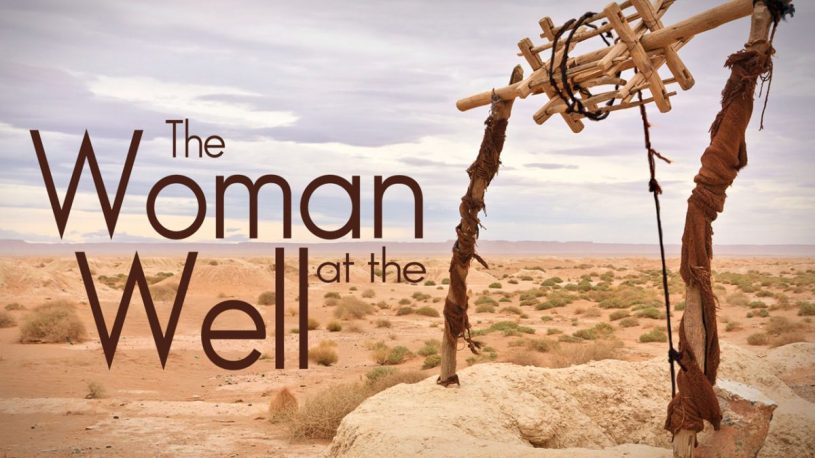
This is a copy of my talk given at Ayia Kyriaki and Saint Luke’s in the Anglican Church of Paphos on Sunday 8 March 2026. The Bible Reading was John:4-29.
Prayer
Heavenly Father,
I thank You for Your word.
By the power of Your Holy Spirit,
May You speak to my heart,
And change my life.
In the precious name of Jesus I pray.
Amen
Introduction
We’re told in vs4, that Jesus “… He had to go through Samaria” To get to Galilee (vs1) but that wasn’t actually the case. There was a route that went through this middle section of the country, and it was a popular route that people travelled on. But it wasn’t the only route. There was an alternative route for pious Jews who didn’t want to go that way. It was longer and involved crossing the Jordan river but at least it avoided travelling through Samaritan country. So, it simply wasn’t true that geographically Jesus had to travel through Samaria. There were no major roadworks on the alternative route. He had a choice. He chose to take this route because he had an appointment in Samaria he must keep.
An Appointment In Samaria
Vs5/6 “… and Jesus, tired as he was from the journey, sat down by the well. It was the sixth hour (12 noon).” Jesus the divine Son of God in human flesh is exhausted and thirsty. And then out of the corner of his eye he sees, vs7: “A Samaritan woman (who) came to draw water.” This is quite unusual. Women normally came for water in the morning or in the evening when it was cooler. They normally came as a group. This woman was on her own. That’s because she was a social outcast. And yet she was the very woman Jesus had travelled all that way to see.
There’s an interesting detail in vs8. “His disciples had gone into the town to buy food.” This seems quite odd when you think about it. How many disciples does it take to buy the sandwiches? How many men does it take to change a lightbulb? None! Real men aren’t afraid of the dark! Why have all 12 of them been sent away to buy lunch? Jesus wants to speak to this woman without the disciples eavesdropping on their conversation. What he has to say are for her ears only.
Jesus asks her vs7: “Will you give me a drink?” This opening question seems quite normal. But in the culture of the day men didn’t speak to unknown women in public. There was a group of strict Jews called the “Bruised and Bleeding Pharisees” who refused to even look at a woman. They got their name because they frequently used to walk into doors and walls as a result of their piety!
But listen to how the Samaritan woman responds. Vs9: “You are a Jew, and I am a Samaritan woman. How can you ask me for a drink?” Jews and Samaritans didn’t associate with each other. Actually, this is the great understatement of this passage. Jews and Samaritans hated each other. It’s a rather long story! Jesus is breaking cultural and religious barriers.
It’s interesting to see the contrast between Nicodemus in ch3 and the Samaritan woman here in ch4. Nicodemus had a name; this woman is anonymous. Nicodemus had influence; she was a nobody. Nicodemus had friends; she was a loner. Nicodemus was informed about religious matters; she was clueless. Nicodemus was respectable, whereas she was rejected by her own people. But Jesus meets with them both. He doesn’t differentiate.
On International Women’s Day is it co-incidental that the Gospel reading is about Jesus’ encounter with the woman at the well? In the Gospel’s we see how Jesus challenged the norms of the time and treated women with compassion and care. He saw women as equal to men and treated them with equal respect. He was certainly ahead of his time.
Margaret Thatcher, known as ‘The Iron Lady’ was Prime Minister of the UK from 1979-1990. Her premiership involved several memorable events: the Falklands War; Miners’ Strike; the bombing of the Grand Hotel in Brighton; Poll Tax Riots; and her dramatic dismissal from office after a cabinet revolt. One of my favourite stories about her is when she was visiting a nursing home and one lady wasn’t paying attention; she apparently asked her: “Don’t you know who I am?” The lady replied: “I don’t! But don’t worry love, matron will be along in a minute, and she will know.” The woman at the well has no idea about the identity of the man sitting next to her.
Living Water
This brings us back to vs10 when Jesus mentions the Gift of God and his identity. What is this gift of God? Jesus calls it living water. Vs11, the woman says: “You have no bucket, and the well is deep. Where can you find this running water? Are you greater than our father Jacob, who gave us this well?” Jesus is not speaking about literal water but is using picture language to speak about the satisfying spiritual life that is available from God to human beings. We have been created to have/need a relationship with him and only when we have one will our souls be satisfied. Augustine of Hippo once said:
“Thou hast made us for thyself, O Lord, and our heart is restless until it finds its rest in thee.”
Human beings are constantly trying to fill the gap, that missing piece that only God can fill. They dig their own wells to find purpose and destiny and meaning and satisfaction in anything but God. It is of course possible to have fun without a relationship with God. But this is short lived and is nothing compared to an authentic relationship with the living God when we live our lives according to his plans and purposes.
Compare this to what Jesus is offering, vs13: “Everyone who drinks this water will be thirsty again, but whoever drinks this water I give him will never thirst. Indeed, the water I give him will become in him a spring of water welling up to eternal life.” Normal water doesn’t last. Our own futile attempts at filling the void are just the same. Jesus talks about the water he gives. The spiritual life. The Holy Spirit. It’s a gift. Not something we earn or something we have naturally within us, and this gift will lead to the genuine satisfaction of faith. This is the gift of God and Jesus claims to be able to give it.
Changing The Subject
Some people think Jesus is changing the subject when he asks this woman to call her husband but, he wants her to understand who he is. This is a painful part of the conversation. She has been through several relationships and would rather not talk about the past in too much detail. So, her reply to Jesus is rather clipped, vs 17: “I have no husband.”
Jesus then reveals to her that he already knows about her past. You are right when you say you have no husband. You’ve had five and the man you are living with is not your husband. In the culture of Jesus’ day this would be deeply shameful. That’s why she’s drawing water on her own in the middle of the day. Well, not quite on her own because she is having a close encounter of the third kind with Jesus.
Jesus already knew what she had done when he sat down beside her. His attitude towards her wasn’t going to change when she told him about her past. But isn’t this the fear of so many people. God shows unconditional love towards us, and he accepts us just as he finds us. Her response in vs19 explains one of the reasons why Jesus decided to bring up her past: “Sir, I can see that you are a prophet.” Not just a stranger asking for a drink or even a Jewish man in his 30’s having a conversation, but a prophet of God who knows secret things. His identity is becoming clearer to her.
One question that has bothered me in this interaction with Jesus and this woman, is this: Why does Jesus speak about her relationships with these men? Why doesn’t Jesus say to this woman, “I saw you doing the dishes just after breakfast?” Or something else that only she would know about? I think it’s because he wants to point out that this woman is looking for satisfaction and is looking everywhere except God. He wants to show her the well of her own digging. She is drinking deeply but drinking in the wrong place.
Where Should We Worship?
Some people think the woman is employing religious diversion tactics in vs19. “That’s enough about my sin, let’s talk about places of worship.” People often do this don’t they? They set up lots of diversionary tactics and defence mechanisms to avoid talking about Jesus – especially if the truth starts to make sense to them. But I don’t think the woman is doing this here. She knows he is a prophet, maybe someone more special. The promised Messiah, perhaps, who, when he arrived, would explain everything.
So, she asks him about places of worship to give him another opportunity to reveal who he is. What Jesus says is completely radical. Forget your sacred mountain and forget Jerusalem with its temple. Those days are gone. Bit like arguing about the benefits of Betamax or VHS! Remember those? Those days are gone. A time is coming and is now here when the true worshippers will worship the Father in spirit and in truth. When we won’t need the temple system and its sacrifices because Jesus will now be the person of sacrifice and so the place of sacrifice will no longer be required.
Conclusion
When we worship God today, we can do so as forgiven people, who have the Holy Spirit of God within us and who serve him in the way he desires us to do. Sincerity is not enough. God wants us to worship him in the right way. That is by obeying the wishes of his chosen King Jesus in our lives.
Whoever drinks this water I give him will never thirst. Indeed, the water I give him will become in him a spring of water welling up to eternal life.
As we continue our journey through the season of lent, may each of us know Jesus as the spring of life welling up within us.
COPYRIGHT DISCLAIMER The text contained in this sermon (except where stated) is solely owned by its author, Revd Paul A. Carr. The reproduction, or distribution of this message, or any portion of it, should include the author’s name.
 revPACman