
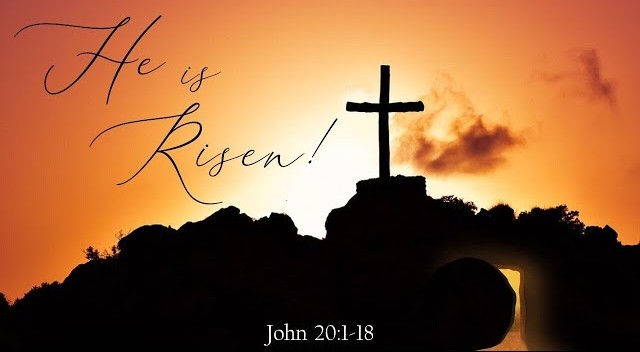
This is a copy of my talk given at Ayia Kyriaki and Saint Stephen’s in the Anglican Church of Paphos on Easter Sunday 5 April 2026. The Bible Reading was John 20:1-18
Prayer
Heavenly Father,
I thank You for Your word.
By the power of Your Holy Spirit,
May You speak to my heart,
And change my life.
In the precious name of Jesus I pray.
Amen
I came across a story recently about a couple from Minneapolis in the USA who decided to go to Florida to celebrate their 20th wedding anniversary. Romantically, they booked to stay in the same hotel they’d gone to for their honeymoon 20 years earlier. The couple were both professionals with hectic lives, and they weren’t able to completely coordinate their schedules. So, the husband travelled down to Florida on the Thursday, and his wife was due to fly down the next day.
The husband checked into the hotel and there was a computer in his room, so he decided to send his wife an email. However, he accidentally left out one letter in her email address, without realising, and pressed the send button.
Meanwhile, somewhere in Houston, a widow had just returned home from her husband’s funeral, who had been a church minister for many years, and decided to check her email, expecting messages of condolence from friends and relatives. But she collapsed on the floor with a scream after reading the first message. The widow’s son rushed into the room, found his mother on the floor, and saw the email which read:
To: My Loving Wife
Subject: I’ve arrived!I know you’re surprised to hear from me. But they have computers here now. And you are allowed to send emails to your loved ones. I’ve just arrived. I’ve checked in. And I see that everything has been prepared for your arrival tomorrow. Looking forward to seeing you then! Hope your journey is as uneventful as mine was.
PS. Sure is hot down here.
Easter Sunday is the story of the impossible – a dead man rises from the dead. Easter Sunday is the story of the ultimate triumph over evil, as God demonstrates his victory over death, the curse of the world. Jesus’ resurrection is, without any shadow of doubt, the most amazing event ever to take place in the history of the world. More amazing than men walking on the moon or space travel (Artemis II); More amazing than the power and wonder of creation; More amazing than the birth of a child; More amazing than …
If Jesus didn’t rise from the dead, as Paul wrote in 1 Corinthians 15, our faith is futile; our preaching is useless; we are still dead in our trespasses and sins; and we, (KJV) of all people, would be most miserable!
Let’s take a closer look at events that first Easter Sunday morning from John 20:1 Early on the first day of the week, while it was still dark, Mary Magdalene went to the tomb and saw that the stone had been removed from the entrance.
Notice Mary’s first conclusion after witnessing the empty tomb is not to believe that Jesus had been raised from the dead. She wasn’t expecting a resurrection. She was on her way that morning to mourn. So, when she got to the tomb, saw the stone rolled away and the body gone she assumed the worst. She presumed someone had taken her beloved Jesus from his final resting place.
Vs2: So, she came running to Simon Peter and the other disciple, the one Jesus loved (John – writer of this Gospel) and said, “They have taken the Lord out of the tomb, and we don’t know where they have put him!”Vs3: Peter and John started for the tomb. Both were running, but John outran Peter and reached the tomb first.
Vs5: John bent over and looked at the strips of linen lying there but did not go in. Then Simon Peter, who was behind him, arrived and went into the tomb. He saw the strips of linen lying there, as well as the burial cloth that had been around Jesus’ head. The cloth was folded up by itself, separate from the linen. Finally, John, who had reached the tomb first, also went inside. He saw and believed.
There are always those who doubt the resurrection ever took place: Some suggest that Jesus merely swooned or went into a coma – but those who were crucified had to be pronounced dead by a Roman soldier before they were taken down from the cross.
A popular theory suggests the disciples stole the body – however, a Roman guard (some of the most vicious and ruthless soldiers the world has ever seen), were keeping watch on the tomb. For them, failure in duty meant instant death. It would have been a miracle in itself for a demoralised group of disciples – who had fled in fear of their lives when Jesus was arrested – to overpower the SAS of the ancient world!
The authorities knew what Jesus had said about rising from the dead, but they couldn’t produce a body to stamp out awkward and embarrassing rumours. And those disciples, who deserted Jesus to save their own skins, were so transformed by their experience in the weeks afterwards; they were willing to be put to death themselves rather than deny the fact they had met the risen Jesus. It just doesn’t seem to add up, does it? I’d put my ‘head on the block’ for a number of things, my family, my integrity, my faith, but I wouldn’t do it for a lie? And I don’t think any of you would too. I read an interview this week with the actor/director Mel Gibson, a devout Catholic, who is writing a sequel to The Passion of the Christ, and he said:
I consider the Gospels to be verifiable history … every single one of those guys [the Apostles] died rather than deny their belief. And nobody dies for a lie. Nobody.
History is littered with politicians, religious leaders, academics, lawyers, researchers, detectives, who have all attempted to establish that Jesus didn’t rise from the dead, yet their conclusions, however disagreeable to them and, sometimes to us, state that only a resurrection from the dead can adequately account for the phenomenon they were investigating.
Now interestingly we’re told in vs9: They still did not understand from Scripture that Jesus had to rise from the dead. Jesus’ resurrection should not have come as a big surprise to his closest followers – did they ever listen to a word he said! Jesus had taught this truth so many times throughout his life (Matt 16:21, 17:23, 20:19, 26:32). Not only did he predict it, but the Old Testament predicted that the Christ, the Messiah of Israel, would be resurrected after he had died for the sins of his people.
Well, poor Mary still hadn’t put two and two together and we’re told vs11 that she stood outside the tomb crying when Peter and John had returned home confident that Jesus had risen from the dead. But Mary was still in a state of troubled confusion, so she decided to have a look inside and that’s when she saw two angels sitting on the place where Jesus’ body had been laid. I love what they ask her. Vs13: Woman, why are you crying? Why the distress on a day like this? Don’t you know it’s resurrection morning? Well, she didn’t know it was resurrection morning. She was still convinced that someone had taken the body of Jesus. She wasn’t expecting a resurrection, and she certainly didn’t believe one had taken place. Someone once wrote:
In many respects I find an unresurrected Jesus easier to accept. Easter makes him dangerous. Because of Easter, I have to listen to his extravagant claims and can no longer pick and choose from his sayings. Moreover, Easter means he must be loose out there somewhere.
And if Jesus is ‘loose out there somewhere’ then we have a responsibility to look for him, don’t you think? But it’s not a game of hide and seek! God doesn’t hide so we have to look for him in obscure places, he isn’t so concealed that we can’t find him.
When Jesus appeared behind Mary he asked the same question as the angels, Vs15: Woman, why are you crying? She thought he was the gardener and said to him: Sir, if you have carried him away, tell me where you have put him, and I will take him away. Jesus replied: Mary. At that moment she must have recognised Jesus’ voice immediately and then the scales fell from her eyes! You’re alive! You’re alive! You have risen!
To quote Martin Luther King, she had been: … lifted from the dark valley of despair to the bright mountain of hope, from the midnight of desperation to the daybreak of joy … and now she is hugging the Lord of glory, and she won’t let him go!
Jesus tells her to let go but not to worry, Vs17-18. It’s okay Mary … I’m not going home to my Father straight away. This will not be the only time you will see me. So, relax … in fact, why not go and tell the others that you’ve had a personal encounter with your risen Lord.
For many people Jesus’ resurrection may be difficult to comprehend. It may exhaust our imagination and push our ability to reason breaking point. But that is no reason not to believe in it, and in what it points to: a God who cares so much that he entered our world, lived our lives, bore our pains and shows us a better way to live. New life comes through death. 1 Corinthians 1:18: For the message of the cross is foolishness to those who are perishing, but to us who are being saved it is the power of God.
Jesus’ resurrection isn’t just a story that sits 2,000 years ago in history. It has meaning, power and hope for us today: meaning that should radically change the way we live our lives, power to transform the darkest situations, hope for even the most broken lives. Jesus’ words to Mary are also words to those of us who celebrate Jesus’ resurrection today … go and tell others that you’ve had a personal encounter with the risen Lord. In order that they, too, might believe.
COPYRIGHT DISCLAIMER The text contained in this sermon (except where stated) is solely owned by its author, Revd Paul A. Carr. The reproduction, or distribution of this message, or any portion of it, should include the author’s name.
 revPACman