
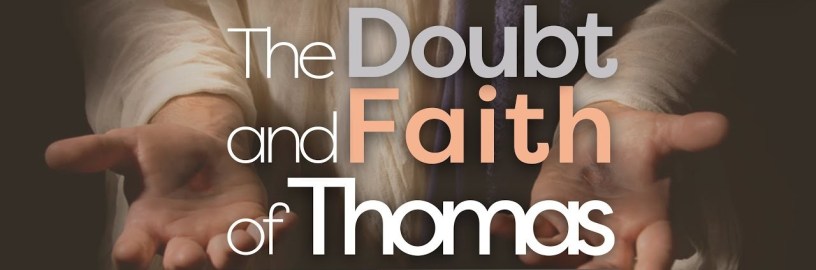
This is a copy of my talk given at Ayia Kyriaki and Saint Luke’s in the Anglican Church of Paphos on Easter Sunday 12 April 2026. The Bible Reading was John 20:19-31.
Prayer
Heavenly Father,
I thank You for Your word.
By the power of Your Holy Spirit,
May You speak to my heart,
And change my life.
In the precious name of Jesus I pray.
Amen
The disciples were together in a house, in an upper room hiding behind locked doors. A number of them had seen Jesus alive, but now they were scared. What were the Jewish leaders going to do? Would they be accused of stealing the body? Would they be arrested? Would anyone believe them if they said that Jesus had risen from the dead?
Suddenly, Jesus was standing in the middle of them and said: “Peace be with you.” Jesus always says just the right thing at the right time, doesn’t he? He tells them that they can feel peace in their hearts. He was there, and they had nothing to worry about. He showed them his hands and side to prove to them that he wasn’t a ghost, but that he was the same Jesus they had known, the same Jesus they had seen crucified just three days earlier.
For some reason, Thomas wasn’t there. We’ve no idea where he was or why he was missing. Was he unwell? Was he too fearful to go to the house? Was he about to give up on being a follower of Jesus? Did he have a prior appointment?
It’s not difficult to imagine the scene when Thomas returned. Straight away he would have noticed the mood was very different from before. The cowards were now full of joy. The tears had been replaced by smiles. And then he would have heard the reason why.
Verse 25: “The other disciples told him, ‘We have seen the Lord.’ But he said to them, ‘Unless I see the nail marks in his hands and put my finger where the nails were, and put my hand into his side, I will not believe it.’”
You can’t get much more sceptical than that, can you? As Victor Meldrew would say: I don’t believe it. Why does Thomas refuse to believe unless he sees visible proof? Might it be because Thomas was a practical person, and lived in a practical world. He was shattered on Good Friday when Jesus died. But he wasn’t about to succumb to fantasy. No one in their right minds would doubt it when the Romans said a prisoner was dead. They were experts at killing!
It’s not that Thomas didn’t want to believe that Jesus was still alive but he knew how the world worked. Dead was dead, and that was it. Many people in our world have doubted the resurrection. Just like Thomas.
Often, we’re afraid to face our doubts because we’re afraid of what we might find. We’re afraid of what others might think. People might find out how weak our faith really is, so we keep our doubts to ourselves. And yet, our doubts don’t go away – they’re always there, and doubt slowly eats away at our faith, until we believe in Jesus less and less, and we become more and more sceptical. Just like Thomas.
Just think about how the justice system works. The normal method is for people to examine the eye-witness testimony of credible witnesses and then come to a conclusion. Once the court has established the witnesses are credible then it believes what they say. In our lives we trust reliable people to tell us about events we have not personally witnessed.
It’s the same with Jesus. We are not being asked to have faith without evidence or have faith despite the evidence. We are being asked to examine for ourselves the trustworthy evidence that God has provided.
What Jesus did for Thomas was an act of grace. Thomas didn’t need an appearance from Jesus. He already had access to another type of evidence. He had the eye-witness testimony of his trustworthy friends. I’m not saying he should have instantly believed them, but it wasn’t a wise move to instantly dismiss them, either.
He should have asked them a few questions, compared their stories, put together the case. He should have engaged with the eye-witness testimony. Thomas wasn’t being asked to make a leap in the dark. He was being asked to make an informed choice based on the reliable testimony of his trustworthy friends.
Authentic Christianity is not opposed to evidence. No one is being asked to close their eyes and believe things they know are nonsense. Being a Christian is about a personal commitment to Jesus. It is a life-changing decision. But it should be made on the foundation of evidence, not in the absence of evidence. We are to use our brains.
History is littered with politicians, religious leaders, academics, researchers, lawyers, detectives, who have all attempted to establish that Jesus didn’t rise from the dead, yet their conclusions, however disagreeable to them and, sometimes to us, state that only a resurrection from the dead can adequately account for the phenomenon they were investigating. The Christian faith is not blind faith. We use our intellect and our hearts.
My Story!
I began searching for that missing piece in my life, after a good friend of mine committed suicide. Although I’d attended Sunday school as a child, my memories of Christianity were of a faith that was ‘Boring, Untrue and Irrelevant.’ So, I began to look around at different religions for the answers to what we call the ‘First order questions of life’ such as: Why was I born? What happens when I die? Is there a God? I was asking myself the question the first session of the Alpha Course asks: Is There More To Life Than This?
I started to investigate different religions (such as Jehovah’s Witnesses, Mormons, Scientologists, Buddhists etc.) and attended several different places of worship and read through a load of ‘religious bumph,’ But what struck me the most, apart from people wanting my money, was how Jesus seemed to be the common denominator between most of the major world religions. They all mention Jesus as being a son of God or a prophet or a great moral teacher – only Christianity gives Jesus centre stage. That seemed quite significant to me.
So, I began to think that I should read more of what Jesus had to say. I began to read the Bible, I started with the first four books of the New Testament known as the Gospels, which tell the story of Jesus’ life and the amazing things he did. And as I looked at the evidence for Christianity, I became convinced it was true.
It’s not just the life of Jesus, which is so important, it’s his death. Christian’s believe Jesus rose again from the dead which makes Jesus distinctively different from any other religious figure the world has ever known. I knew from my research that I had to make a decision with my heart as well as my mind. I remembered a Bible verse from Sunday school: John 10:10. I cried out a prayer in desperation that God answered and, of course, my life hasn’t been the same since.
You’ll have heard the phrase: My life was turned upside down. But as I often say, my life was turned downside up when I became a Christian! It all seemed to make sense! My faith moved 18 inches. It moved from my head to my heart!
It’s important to realize that wanting evidence is not a bad thing. Richard Dawkins defines faith as “Blind truth, in the absence of evidence, even in the teeth of evidence.” But this is not how the Christian faith operates. Hebrews 11:1: Now faith is the substance of things hoped for, the evidence of things not seen.
Verses 26-28: “A week later his disciples were in the house again, and Thomas was with them. Though the doors were locked, Jesus came and stood among them and said, ‘Peace be with you!’ Then he said to Thomas, ‘Put your finger here; see my hands. Reach out your hand and put it into my side. Stop doubting and believe.’ Thomas said to him, ‘My Lord and my God!’
The first thing to notice is that Jesus doesn’t say “Shush. Be quiet Thomas. You’ve got it all wrong. Go wash your mouth out.” He doesn’t say this. He accepts his confession to be true. Thomas was cured of his doubt and responded by saying, “My Lord and my God!” Thomas had become a man of faith, a man who believed in Jesus, even though everything he knew about the world would tell him otherwise.
The only solution, the only way, that you can get rid of the doubt in your heart is to have moments with Jesus, like Thomas had that Sunday after Easter. “Now wait a moment,” you might say. “Jesus appeared to Thomas. How am I supposed to have a moment like that?” When does Jesus come to you, and speak to you, like he spoke to Thomas? When does Jesus chase away your doubts? When does he transform you into someone who strongly believes in him, like Thomas did after it was all over?
Every time you hear the Word of God, Jesus steps into your life and says, “Peace be with you.” Every time you receive the Lord’s Supper, Jesus is right there, and he chases away your doubts, and fills you with faith and hope and trust in him. Through times of quiet and conversation; through prayer and worship; through liturgy and, sometimes, just sometimes, through the preaching of His word. God also communicates with us through friends; family; workmates; TV; media; newspapers; music; culture; etc.
God communicates with us all the time but it’s a question as to whether we can, or choose, to pick it up. Frederick Beuchner writes:
Morning, afternoon, evening – the hours of the day, of any day, of your day and my day. The alphabet of grace. If there is a God who speaks anywhere, surely, he speaks here: through waking up and working, through going away and coming back again, through people you meet and books you read, through falling asleep in the dark.
In verse 29, Jesus says to Thomas: “Because you have seen me, you have believed. Blessed are those who have not seen me and yet have believed.” Jesus is talking about you and me. We have not seen him with our own eyes like Thomas. But we have believed. We have believed by having Jesus come to us in an invisible way, through his Spirit.
It’s important to get clear what Jesus is not saying. He is not saying that the really blessed people are those who believe in spite of the evidence. It’s not a contrast between evidence-based faith and blind trust. It is a contrast between different types of evidence.
The Apostle John tells us vs30-31, that Jesus did other miraculous signs that are not recorded in the Bible. “But these are written” (these stories, these accounts of Jesus) “that you may believe that Jesus is the Christ, the Son of God, and that by believing you may have life in his name.”
In closing, make the most of fellowship and the encouragement of other Christians. Read His word and let Jesus speak to your heart, just as he spoke to Thomas. Let Jesus take away your doubts. Let Jesus strengthen your faith as someone who strongly believes that Jesus is the Christ, the Messiah, even though you have never seen him. May God grant to each one of us, the same heart he granted to Thomas, a heart that says, “My Lord and my God.” Amen.
COPYRIGHT DISCLAIMER The text contained in this sermon (except where stated) is solely owned by its author, Revd Paul A. Carr. The reproduction, or distribution of this message, or any portion of it, should include the author’s name.
 revPACman