
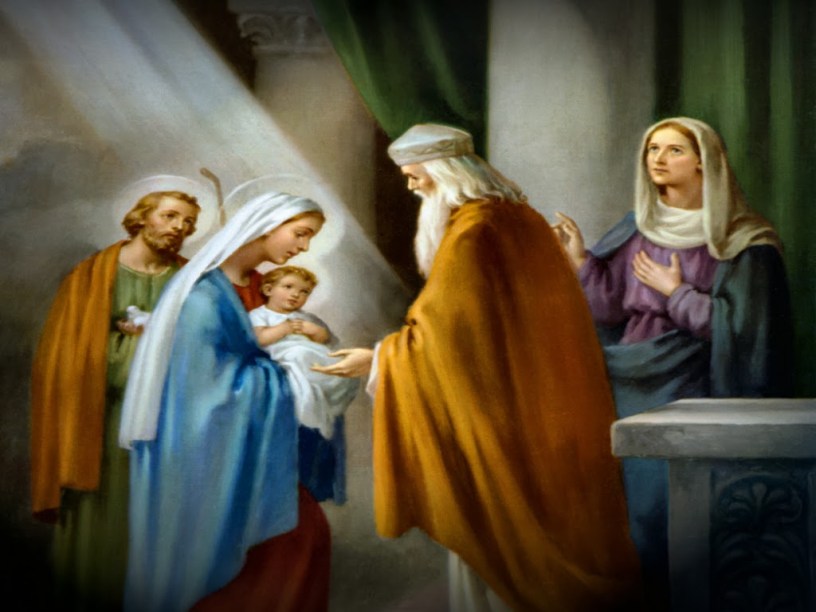
This is a copy of my talk given at Saint Luke’s, Polis in the Anglican Church of Paphos on Sunday 28 January 2024. The Bible Reading was Luke 2:22-10.
Prayer
Heavenly Father
I thank You for Your word
By the power of the Holy Spirit
May You speak to my heart
And change my life
In the precious name of Jesus I pray
Amen.
Introduction
Candlemas is also known by two other names – the Presentation of Christ in the Temple and the Purification of the Blessed Virgin Mary (I wonder if some of the ladies remember the old ‘Churching of Women’ service that used to take place soon after a woman had given birth?).
The feast was first celebrated in Jerusalem in the fourth century. In 542 the Emperor Justinian ordered its observance at Constantinople as a thanksgiving after a plague and then the custom spread through the east.
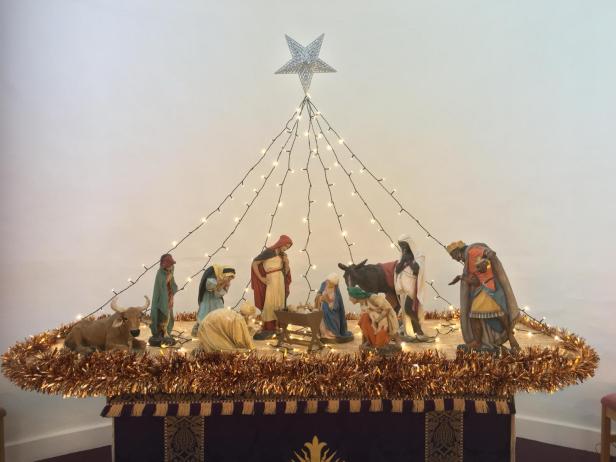
Candlemas is officially celebrated on 2 February and it marks the end of the Christmas/Epiphany season and, if you haven’t taken down your decorations yet, you really must do so. I know some churches wait until Candlemas to remove their nativity scenes (I always have) – at least you get your monies worth!
When Jesus was still a babe in arms, Mary and Joseph followed a law God gave to Moses that parents should take their firstborn son to the temple for a service of dedication. It was a bit like one of our Services of Thanksgiving, when parents say thank you to God for the safe arrival of their children and commit themselves to bringing up their child in God’s ways.
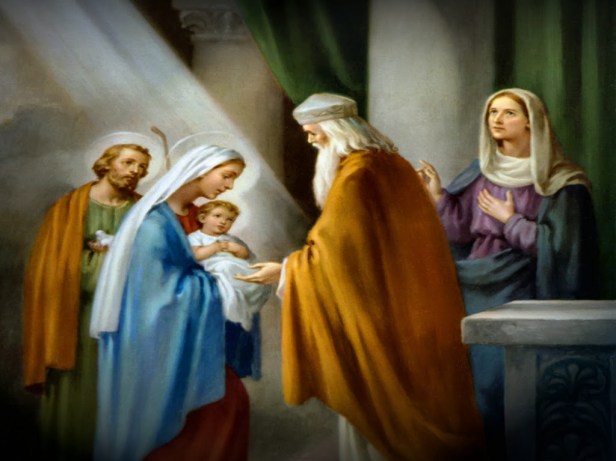
The Law required a Lamb and a pigeon to be offered, however, if parents couldn’t afford a Lamb, then an extra Pigeon would be accepted, and it was a pair of pigeons which were brought to the Temple (2:24); and it’s for this reason we know Mary and Joseph weren’t well-off when it came to money. Simeon and Anna tell Mary and Joseph about what he would become and the impact he would have in his lifetime – and beyond. There are five important lessons that we can learn from these two godly old saints:
1) The Importance of Patience
Simeon had been waiting for the consolation of Israel and he’d been told by God that he wouldn’t die until he’d seen it for himself – Simeon was, tradition says, was 113 years old.
Anna had been waiting for what she calls the redemption of Israel but we do know that Anna was 84 years old. Both of them were devout and godly people of what we call the Third Age and God fulfilled the promises they had been waiting a whole lifetime to hear.
But to understand something of their patience, we need to go back 450 years in Jewish history to the last time God spoke to his people through the prophet Malachi: it was then that God promised that he would come personally into the world and bring about salvation in the form of the Messiah. Can you imagine the excitement in Simeon’s soul when he heard that after all those years of silence, he would actually witness this great coming?
You can imagine Simeon scanning every child that came into the Temple courts: asking: “Lord, is this the one?” “Is that the one?” “What about him over there?” And Anna was patient, too. She’d been attending the temple for 84 years. Can you imagine being that patient? It’s a reminder that God never lets us down – but also that we’re never too old to be used by God!
2) The Importance of Praise
Now if you can imagine that scene in the busy temple courts that day, you would have seen a picture of pure happiness. Two elderly people hunched round a baby and his parents. All filled with joy and delight that, after all this time, the promises of God are being fulfilled. At last, the waiting is over. At last, Simeon can go to his grave a contended man. At last, the hope of salvation has dawned.
And what a moment this must have been as Simeon held the baby Jesus in his arms and, as he does so, speaks those famous words of praise and thanks to God (words known in Latin as the ‘Nunc Dimitis’), vs29- 32:
Sovereign Lord, as you have promised, you now dismiss your servant in peace. For my eyes have seen your salvation, which you have prepared in the sight of all people, a light for revelation to the Gentiles and for glory to your people Israel.
This is quite an interesting ‘missionary hymn’ because, quite unusually for a Jew, it speaks of this salvation being revealed to the Gentiles. Jesus has restored the glory to Israel and brought the light to the Gentiles so that all people can be saved.
3) The Importance of Prophecy
Anna would also have read the prophecies, and she, with Simeon, was also looking forward to the coming Messiah who would bring salvation to the world. There’s no doubt that Simeon knew the teaching about the Messiah, and he wasn’t going to keep this ‘longing of a lifetime’ to himself and so: he prophesies, he speaks God’s truth: that Jesus will raise up those who believe in him but will be a stumbling block for those who disbelieve; in short, he prophesies that Jesus is going to divide opinion. And that’s as true in Jesus’ lifetime as it is today.
But as well as Simeon also prophesying that through Jesus the whole of the non-Jewish world would get to know about God’s salvation, there was an unexpected twist, wasn’t there? Just at the point when Simeon blesses Jesus, Simeon prophesies to Mary, vs34: ‘This child is destined to cause the falling and rising of many in Israel, and to be a sign that will be spoken against, so that the thoughts of many hearts will be revealed.
And almost as a footnote, Simeon also prophesies that his death would be a cause of great sorrow to Mary: And a sword will pierce your own soul too. And there is no doubting the truth of Simeon’s prophecy about the impact Jesus would have on the world during his lifetime and throughout world history. I wonder how Mary received Simeon’s words of the heartbreak to come when he said: And a sword will pierce your own soul too. I’m sure those words came back to her when she was present at Jesus’ crucifixion.
4) The Importance of Prayer
This story tells us that our relationship with God is built up through praise and prayer. And in our reading, we heard that Anna never left the Temple but worshipped night and day, fasting and praying (2:37). Overwhelmed, perhaps, with grief on the loss of her husband, Anna dedicated herself to serving God in the temple.
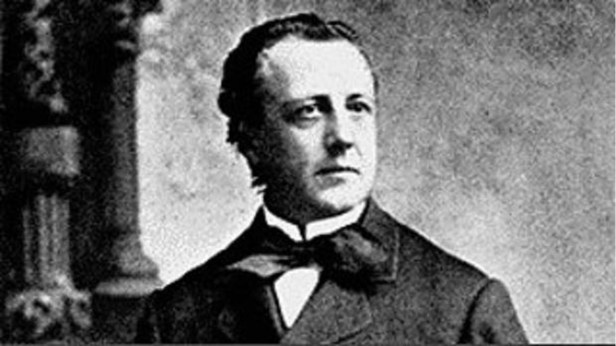
Joseph Scriven, the writer of the hymn; What a friend we have in Jesus had a similar experience when he wrote his hymn about prayer as a response to a crisis of faith after enduring the agony of his first fiancé dying from TB and his second fiancé drowning on the eve of their wedding day. The hymn includes the words:
What a friend we have in Jesus,
all our sins and griefs to bear,
what a privilege to carry
everything to God in prayer.
So why is prayer important?
Prayer develops our relationship with God. And in this relationship, we find the very meaning and purpose of our lives. Prayer should never be considered as a one-way phone call like leaving a message on an answering machine. Prayer allows us to hear God – and it’s vital that we listen.
Prayer satisfies that spiritual hunger we all have. It quenches our spiritual thirst. It refreshes our soul. Philip Yancey is his book: ‘Prayer: Does it make any difference’ writes: The main purpose of prayer is not to make life easier, nor to gain magical powers, but to know God. I need God more than anything I might get from God.
Prayer gives us perspective. One of the things I find is when you start to thank God in prayer, when you start to say: ‘Oh, Lord, thank you that…’ Thank you that I’m alive! Thank you for the sunshine. Thank you for the blessings. Thank you for family. Thank you …’ and you start thanking, and you suddenly realise: ‘Wow, there’s so much to thank God for!’ And it puts your problems, your worries, in perspective.
Prayer changes situations. Prayer not only changes us, it also changes situations. Because, as we pray, we begin to see the world around us through God’s eyes, rather than our own, and our prayers become different too? I never cease to be amazed what happens when we pray. Former Archbishop of Canterbury, William Temple said: When I pray, coincidences happen, and when I don’t, they don’t.
5) The Importance of Purpose
Anna, and Simeon, knew what it was to find purpose for their lives through their worship of God. It brought meaning and hope in their life-long quest to meet the Messiah themselves.
Conclusion
From the example of Simeon and Anna, we recognise the importance of being Patient when it comes to God’s promises; the importance of (daily) Praise and Prayer as we deepen our relationship with him; the importance of being open to God speaking words of Prophecy and truth into our hearts, through his words and through the words of others. It seems to me that it’s because of these things that Simeon and Anna found themselves to be exactly where they needed to be in order to see the Messiah with their own eyes. Coincidence or God-incidence?
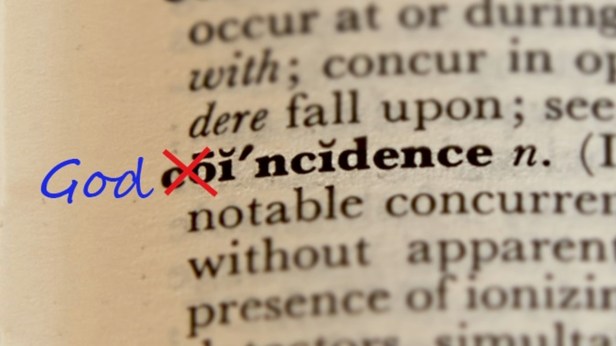
You choose!
COPYRIGHT DISCLAIMER: The text contained in this sermon is solely owned by its author, Revd Paul A. Carr. The reproduction, or distribution of this message, or any portion of it, should include the author’s name.
 revPACman