
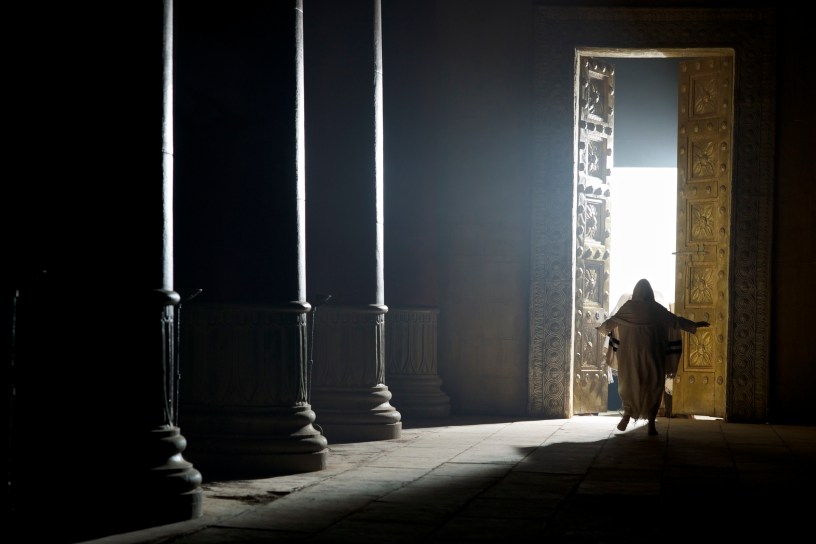
This is a copy of my talk given at Ayia Kyriaki at the 8.30 am and 6.00 pm services in the Anglican Church of Paphos on Sunday 3 March 2024. The Bible Reading was John 2:13-22.
Prayer
Heavenly Father
I thank You for Your word
By the power of the Holy Spirit
May You speak to my heart
And change my life
In the precious name of Jesus I pray
Amen.
Introduction
What gets you worked up or excited? People get worked up and excited over so many different things, don’t they? Some are energized by work or their gardens. Some people get worked up over political issues. I know some who get excited over ‘planes, trains and automobiles.’ Some people get excited about music and some about sport.
It’s difficult to imagine how Jesus must have felt when He approaches the temple and finds it filled with merchants and moneychangers. It challenges the soft-spoken, almost feeble image of Jesus we often visualize. Here, Jesus is worked up, agitated and angry. That’s right, Jesus got angry. Now his anger was not sinful anger, as we might know anger, because He was angry for the right reason. He had a legitimate reason to be angry.
What were they doing there in the first place? You might ask. The purpose of these merchants and moneychangers was two-fold. One, many of the people did not bring animals with them for sacrifice, so they purchased animals there in Jerusalem. Second, all Jewish males were required to pay a half-shekel temple tax in the coinage of the temple (taxes were prevalent even in the first century – a worship tax). Furthermore, foreign monies bearing the image of a pagan deity or ruler were unacceptable; therefore, the money changers would exchange their coinage for a small fee.
Previously, these activities took place outside of the temple, but now the merchants, animals, and exchangers have moved inside the temple courts. The sacredness of the temple has been bartered for profit and convenience. And, as Jesus approached the temple, he becomes angry at what the temple has become.
We read that Jesus makes a scourge/whip of cords and drives away the merchants. He overturns the tables of the money changers and drives out animals and commands the profiteers to get out of the temple. “Stop making My Father’s house a marketplace” he orders. This picture of Jesus (found in all four gospels) is one of the more uncommon images of Jesus.
This lets me know that sometimes it is okay to get angry when the things of God are being defiled. Sometimes anger is appropriate. It’s good to have righteous zeal about the things of God. I remember when I was a curate one of my churchwardens calling me zealous during a time of vacancy. He meant it as an insult, but I took it as a compliment! J.I. Packer writes:
Zealous folk are sensitive to situations in which God’s truth and honour are in one way or another being jeopardised and, rather than let the matter go by default they will force the issue on people’s attention in order to compel, if possible, a change of heart about it – even at personal risk.
I think this sums up Jesus’ approach in the temple! I’ve been in church circles for over 40 years and I’ve seen how church members and leaders/ clergy who are filled with passion for the things of God are often kept at arm’s length. I often wonder how Jesus would fit in if he was around today.
When the name of God or Jesus Christ is cursed, blasphemed, or used as a byword, it should fill us with righteous indignation. Sometimes it is right to get angry as Jesus did over the desecration of the things of God.
Jesus took this desecration personal. Jesus’ actions cause an immediate response by the religious leaders. However, they are not concerned as much about what Jesus did as they are about who did it. The cleansing did not bother them as much as the fact that Jesus did not have their approval.
“Who are you to cleanse the Temple?” “Who gave you the right to do this?”. “Give us a sign that validates who you are.” I love Jesus’ response here. He doesn’t accommodate their request for a sign by pulling out His resume to validate who He is. He doesn’t perform some spectacular miracle on cue to try and persuade them that He is the Messiah. Instead, he confuses them even more. “You want a sign. I will give you a sign. Destroy this temple, and in three days, I will raise it back up.”
We know that Jesus is not speaking of destroying the literal temple, but rather he is talking about His own body – that He will be destroyed and then raised back to life. Not only would Jesus cleanse the temple. He would replace it. He would fulfil its purpose. But the Jewish leaders have no idea what Jesus is talking about, we see this confusion by the Jewish leaders’ response:
“It took 46 years to construct this Temple, and you are going to raise it up in 3 days? Are you out of your mind?” They miss it. They miss Jesus’ testimony of his death and resurrection. And only after Jesus’ resurrection do his followers remember and understand what he was saying.
As Paul wrote in 1 Corinthians 1:18: “For the message of the cross is foolishness to those who are perishing, but to us who are being saved, it is the power of God.”
A number of errors were being committed by the merchants and moneychangers and the religious leaders too.
1) They were using the Temple for convenience.
They were making the Temple a convenient place to purchase animals. And, whilst they could be said to be meeting the needs of the people, they were doing so at the expense of the temple’s sacredness. It was meant to be a Holy Place. The Lord’s house is not a place for convenience. And, whilst we want our churches to be accessible and convenient for people to attend, we must never exchange the sacredness of the Lord’s house for convenience’s sake. Serving Jesus is not always about convenience. It is about commitment.
2) They were using the Temple for business.
We are all familiar with religious organizations that seem to have nothing but the all-mighty pound/dollar/euro in mind. There are many modern-day temple merchants. I believe that our facilities should be well cared for and that we should be wise stewards with what God has blessed us with, but we can never let money be what drives our ministry. God’s house is a place for prayer, brokenness, contrition, worship, study, and praise. It is not a place that should be desecrated with the bellowing of cattle and bleating of sheep. When we come to the house of the Lord, we come for the purpose of gathering to worship, not to conduct business.
But what was taking place in the Temple Courts was merely a reflection of the shallow religion inside the Temple. The Temple was being misused because it was not respected. In the NT, we are taught that we, our bodies, are the temple of the Holy Spirit and just as Jesus was angered by the defiling of the Jerusalem Temple, He is grieved when we allow our bodies, to be polluted and defiled through sin in our lives.
3) They misinterpreted what Jesus said about the Temple.
The religious leaders totally missed Jesus’ prophecy regarding His resurrection. They misinterpreted His sayings because they were looking for signs instead of transformation. Signs are great, but they can be shallow. There are many who are searching for signs. They read the Bible or other religious material searching for some miraculous sign to reveal the truth: the religious leaders made the mistake of looking at the temple itself and they missed what Jesus was really saying. They were focused on the building. “How can you destroy and reconstruct a temple that has taken 46 years to build?”
Christianity is not about a church building – no matter how iconic some of our buildings might be. It is not about a philosophy of life or a belief system. Christianity is about a relationship with Jesus. It is about believing in the good news that Jesus is the son of God who died for our sins and rose again from the dead. It is what we believe when we recite the Creed.
Conclusion
Chapter 2 concludes by telling us that there were many in Jerusalem who believed in Jesus based solely upon His signs, but Jesus didn’t entrust Himself to them. In other words, Jesus knew their hearts. He knew the difference between superficial faith and genuine faith.
Many claimed to believe in Him because they witnessed miraculous events taking place, but Jesus knew what was in their hearts. He knows those who truly believed in Him. Jesus did not come as a magician, but as a Saviour. But those who embraced him because of the miracles, missed it.
An anonymous poet once said:
If our greatest need had been information, God would have sent us an educator. If our greatest need had been money, God would have sent an economist. If our greatest need had been technology, God would have sent us a scientist. If our greatest need had been pleasure, God would have sent us an entertainer. But our greatest need was forgiveness, so God sent us a Saviour.
In what are you trusting this morning/evening? We’re called to accept God’s forgiveness in Jesus our Saviour and to accept that divine forgiveness is often enacted and made real, through holy righteous indignation; sometimes our world has to be turned downside up before we get it.
COPYRIGHT DISCLAIMER: The text contained in this sermon is solely owned by its author, Revd Paul A. Carr. The reproduction, or distribution of this message, or any portion of it, should include the author’s name.

