
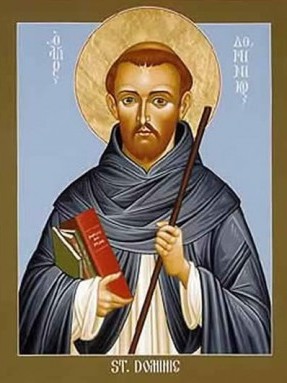
On 8 August the Church remembers Dominic de Guzmán (1221) also known as Saint Dominic, founder of the Order of Preachers (Dominican Friar’s).
For a Christian to live one’s life entirely consumed by Christ, to be united with Him in prayer, to have the Name of Jesus always on one’s lips, might seem an impossible ideal. And yet, we know of great men and women throughout history who have lived up to that ideal more or less closely. One of these was Dominic de Guzman, a contemporary of Saint Francis of Assisi, who, like Francis, tried to conform his life to the model of Jesus Christ.
But who was Dominic de Guzmán?
Dominic was born in Spain, in Caleruega, Old Castile. He studied Arts and Theology and joined the order of Canons at Osma Cathedral. A philanthropist, he sold his books to feed the poor during a famine. In 1201 Dominic accompanied Diego, the Bishop of Osma, to Northern Europe, where he became interested in missionary work.
On his way home Dominic travelled through France and was shocked at the wide spread of heresy that he found. In particular he reacted against the Albigensians (a dualistic sect). After sitting up all night talking to an Albigensian innkeeper, and eventually seeing the innkeeper become an orthodox Christian, Dominic saw that the only effective way to rid the Church of heresy was good teaching.
Much of the Albigensian doctrine was formed through a purely allegorical interpretation of the New Testament, and to counter this Dominic planned a monastic order devoted to teaching and preaching. He intended that the members of his order would be trained properly, and live a life of austerity. The order had its own schools and new members often went to universities. The first house he founded was at Prouille (1206).
Dominic taught that his preachers should live a life of poverty far greater than the teachers of false doctrine. He also taught that they should teach the true doctrine of the Church by persuasion, power and learning. Both of these ideals were a divergence from normal church practice at the time.
Since there were many ‘new’ orders in the thirteenth century, Dominic was dissuaded from writing a new ‘Rule’ and adopted the Rule of St Augustine for his order. The Order of Preachers was given authority by Pope Honorius III in 1216. In 1217 Dominic began to send his friars to other parts of the world, where they frequently attached themselves to universities. In 1220 an official gathering of the order established a constitution, and laid the foundation for an order of Dominican nuns.
Dominic had zeal for teaching and for combating heresy. He refused the position of bishop three times so that he could concentrate upon his mission. He flew in the face of accepted church action and rejected finery and position, preferring the way of humility and prayer. He took the gospel into hitherto unreached or ignored areas – the cities and the universities – and engaged those he met with persuasive teaching, grounded in an experience of God.
The ‘Life of Dominic’ attests to these attributes of humility and example: A general debate with the heretics being agreed upon, the bishop of the place wanted to attend in state with a pompous retinue, but Dominic addressing him, said: ‘It is not in this fashion that we ought to meet them, but we should rather strive to win them over by our humility and virtuous example, than by mere show and display or by contentious words: and since the present meeting is not without its fears, let us arm ourselves with humility and go barefoot (The Life of Dominic, Ch. 2, c.1255).
A Prayer
Almighty God,
whose servant Dominic grew in the knowledge of your truth
and formed an order of preachers to proclaim the faith of Christ:
by your grace give to all your people a love for your word
and a longing to share the gospel,
so that the whole world may come to know you
and your Son Jesus Christ our Lord,
who is alive and reigns with you,
in the unity of the Holy Spirit,
one God, now and for ever.
Amen.
Revd Paul A. Carr & Extract from Saints on Earth: A biographical companion to Common Worship by John H Darch and Stuart K Burns

