
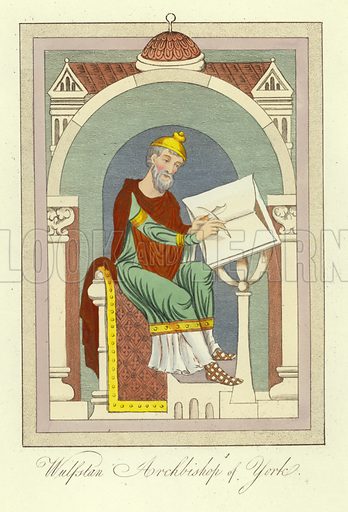
On 19 January the church remembers Wulfstan, Bishop of Worcester and Patron Saint of vegetarians and dieters, and a pioneering anti-slavery campaigner, 1008-1095.
But who was Wulfstan?
Wulfstan is known as Wulfstan II, so as not to be confused with his predecessor c.900 who became Archbishop of York.
Wulfstan was born in Long Itchington in Warwickshire in 1008, and educated at the monasteries of Peterborough and Evesham. He became a Benedictine monk after refusing the offer of a richly endowed parish church on the occasion of his ordination. He settled in the small monastic community at Worcester Cathedral and in 1050 became prior.
In 1062 Wulfstan was consecrated Bishop of Worcester. He combined his roles as bishop and prior with great success, being passionate and vigilant in both. Thorough and systematic in his pastoral care, he is the first English bishop to be known to have made a complete visitation of his diocese.
Wulfstan was fully involved in the revitalization of monasticism in the second half of the eleventh century, building upon the work of Dunstan, Oswald and Ethelwold. As part of the second stage of that reform Wulfstan oversaw the introduction of laws and canons reforming the role and conduct of the clergy. He facilitated the relationships between the Church and the State.
Wulfstan was the first bishop to pay homage to William the Conqueror after the battle of Hastings, and he remained one of the few Saxons to keep his high office to the end of William’s reign. In terms of administrative reform, Wulfstan increased the use and effectiveness of the archdeacons, particularly within large dioceses.
Wulfstan was influential in monastic reform. He encouraged a wider understanding of public penance, and brought up to date a full penitential system based on Frankish precedents. He also taught against the proliferation of pagan customs throughout the land.
Wulfstan was one of the most important church leaders of the eleventh century and the most renowned intellectual figure of the late Saxon Church. An energetic and powerful preacher, he was not only the mainstay of monastic reform but was also one of the most commanding figures of the monastic intellectual revival, having a great ability to clarify and explain the teaching of the Church.
In an age where clergy in general and Bishops in particular could enjoy the good life, Wulfstan was something of a social campaigner. It’s said he once invited a host of civic dignitaries to a banquet and then turned up with hundreds of poor people, and insisted that the nobles serve them. He also had a daily ritual of washing the feet of poor people.
He also campaigned vigorously against the slave trade based in the city of Bristol. At the time people who could not pay their debts were being sold into slavery in Ireland. Wulfstan spent time in Bristol, preached sermons attacking slavery and eventually slaves held captive in Bristol were released. At the time slavery wasn’t considered immoral, so his stand was a brave one as Wulfstan persuaded the traders of Bristol of the sanctity of life and the human right to freedom.
According to tradition, Wulfstan died during his daily ritual of washing the feet of twelve of his parishioners. He was canonized in 1203.
Prayer
Lord God,
who raised up Wulfstan to be a bishop among your people
and a leader of your Church:
help us, after his example,
to live simply, to work diligently
and to make your kingdom known;
through Jesus Christ your Son our Lord,
who is alive and reigns with you,
in the unity of the Holy Spirit,
one God, now and for ever.
Amen.
Revd Paul A, Carr and extract from Saints on Earth: A biographical companion to Common Worship by John H Darch and Stuart K Burns
 revPACman