
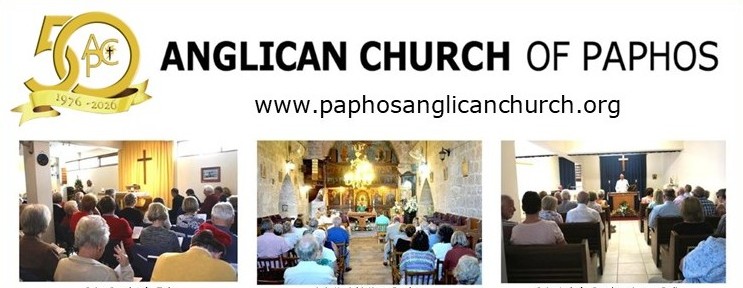
This is a copy of Bishop Sean’s talk given at the Golden Jubilee Celebration service of the Anglican Church of Paphos on Sunday 19 April 2026. The Bible Readings were Leviticus 25:8-12, 1 John 3:1-24 and Mark 2:18-22. You can download a copy of the service sheet here 50th Anniversary Celebration Service at AK
In our first reading, the priestly scribe of Leviticus calls on his people to sound the trumpet to hallow the fiftieth year , and to proclaim a year of Jubilee. This year is a “double Jubilee” for the Anglican faithful of Paphos, as both their parish and diocese celebrate Golden Anniversaries.
It is perhaps more accurate to say that we are celebrating the Jubilee of our parish and diocese “in their current form” – for both have a much longer backstory.
From 1881 British military chaplains based at Polemidia Camp, near Limassol, began to provide ministry to Anglican civilians living in Paphos. Around the same time under the authority of the Archbishop of Canterbury, the Anglican Bishopric of Jerusalem was created, with oversight over Anglican ministry in Cyprus and the Trucial States of the Persian Gulf.
In large part due to the development of the oil industry, Anglican churches in the Middle East were established and began to flourish during the 20th Century. In Cyprus church growth was more modest. As an example of this, for most of the 20th century a combination of military chaplains and clergy from St Barnabas’ Anglican Church in Limassol continued to offer remote ministry to the Anglicans of Paphos, as Paphos had neither its own priest nor a permanent place of worship.
But 50 years ago there was an inflection point, a moment of significant change, in both the diocese and this parish.
On the Feast of the Epiphany 1976 the Archbishop of Canterbury handed over his authority to the Provincial Synod of Jerusalem and the Middle East, and in that moment a new autonomous Province of the Anglican Communion in the Middle East was created; and the Diocese of Cyprus and the Gulf was born.
In 1975, due to the generosity of the Orthodox Bishop of Paphos, Metropolitan Chrysostomos, permission was granted for Anglicans and Latin Catholics to hold services in the old Orthodox church of Ayios Antonios.
Our first bishop, The Right Reverend Len Ashton asked the chaplaincy team of RAF Akrotiri for spare church furnishings and holy vessels so that the church could be properly equipped for services, and on Easter Sunday evening, the 18th April 1976 – exactly 50 years ago yesterday – Bishop Len conducted the first Anglican service at Ayios Antonios.
In 1988, the Anglican congregation relocated from St Antony to Ayia Kyriaki, having accepted the Orthodox invitation to share use of the church once again with the Latins.
Finally in 1992 the Anglican Chaplaincy of Paphos was created with the Reverend Canon Derek Gibbs appointed and installed as the new chaplaincy’s first incumbent.
Eight years later, a new church was planted in Tala and in 2001 its new premises were dedicated to St Stephen. And in 2006 St Luke’s Prodromi came into being. The three congregations of Agia Kyriaki, St Stephen’s, and St Luke’s now constitute the Anglican Church of Paphos.
As we look back on the history of this parish and our diocese, we observe a parallel track of development and growth as the Holy Spirit has guided and provided for God’s people. We are not what we were 50 years ago, and we would be unrecognisable to our spiritual forebears of 150 years ago.
What stands out for me as we look back on the history of this parish is how, for the majority of the 20th Century, Paphos had neither priest nor permanent premises. This speaks to me of the wider reality of ministry in this Diocese – it is simply not an easy place in which to brings churches into existence or to maintain them. We seem to never be far away from some type of cliff edge. The third bishop of the Diocese, the Right Reverend John Brown famously entitled his memoir, “Mainly uphill. A bishop’s journey.” I would have to echo that sentiment – but I will equally say, we are here – by God’s grace.
And so, in this moment, during our Jubilee service, let us humbly give thanks to Almighty God for the guidance, protection and provision our Diocese and parish have received over 50 years and more. And let us also recognise with deep gratitude the faith, commitment and sacrifices of our Anglican forebears who have prepared the ground and planted the seeds that we are watering and nurturing.
What then of the future? As Christians we believe that the future lies in God’s hands – only the Risen Christ, the Lamb that was slain, is worthy to break the seven seals of the scroll of human history and unroll it to its rightful conclusion.
But it seems that we are at another inflection point in our history as a Diocese. The recent episcopal interregnum brought many issues to the surface that had been hitherto minimised or ignored.
In no particular order these are:
- The Gulf Archdeaconry encompasses 80% of the countries of the diocese, 75% of its parishes, and provides 65% of Diocesan income. We are not a diocese of two equal parts and thus our self-understanding, structures and representation need to reflect this reality.
- Local governments have increasingly insisted on regulating churches both in Cyprus and the Gulf which dilutes the episcopal and constitutional authority of the Diocese.
- Our financial model of requiring diocesan contributions from 10 separate countries or jurisdictions is now deeply compromised by stringent international fiscal controls that impede money being sent overseas.
- We are in no way, shape, or form a Western Diocese. The majority of our parishioners come from the Indian subcontinent, Southeast Asia, and Africa. Westerners now comprise about 5% of our worshippers. We are not the Church of England nor the Anglican Church of South Africa nor the Church of South India. We have our own unique identity as an Anglican Diocese in the Middle East that ministers to expatriates drawn from all over the world.
- The current US/Israel war with Iran has shattered the sense of security and prosperity that many expatriates enjoyed in Gulf countries, and it is likely to precipitate further demographic shifts in the Gulf.
All these sociopolitical factors have stretched the existing wineskins of our self-understanding, functioning and structures as far as they can stretch, and it is my absolute belief that God’s Holy Spirit is simultaneously renewing and equipping us as a diocese and churches to meet the spiritual needs and challenges of each generation.
Our Gospel reading reminds us as individuals, parishes and as a diocese that we need to be open to the regenerating, reforming new wine of the Holy Spirit. And such openness will be sacrificial and contentious because most of us desire the security and comfort of “business as usual”, old wine, old wineskins. We will wrestle with questions about what is essential in “the former things” ; what is valuable in new structures, policies, and practices and how these can be blended into something recognisable and fit for purpose. But we cannot be proverbial ostriches, nor can we afford to see ourselves as curators of holy museums. We must strive to discern, to keep in step with the Holy Spirit and allow ourselves to be renewed and transformed by grace.
At a Diocesan level such discernment, and proposals for renewal and reform are being undertaken by the Bishop’s Task Force and Constitutional Review Committee. This is essential work for we must keep in step with what Christ by his Holy Spirit is calling us to do here and now, and our structures and operation must be fit for purpose. I trust that the same openness to the leading and transforming presence of the Spirit is present in the Anglican Church of Paphos.
In closing I would like to comment briefly on our rather long second reading today, and specifically the line,
“See what love the Father has given us, that we should be called children of God, and that is what we are…”
You are counted among the children of God in Paphos. We as the Anglican Diocese of Cyprus and the Gulf are some of the children of God in the Middle East. That is what we are.
And as children of God in these places, it is not always possible to speak openly about our faith in a Heavenly Father, and so it is our behaviour that reveals Christ to others. Our behaviour is the only bible some people will ever read.
Remembering what we are, and how we should behave, is particularly important in times of stress or conflict. The present war has revealed much about the faith and character of people and parishes in our diocese, and equally the conflicts that erupt from time to time in every parish can be very revealing.
Many people ask me what it is like being a bishop? At times there are extraordinary opportunities and there is a deep sense of privilege and blessing. But too often it is a ministry that reminds me of being the customer service hotline for an IT company… the people you phone when there is something wrong with your computer.
I say this because the classic questions that the IT support people ask are:
- Is the computer plugged in?
- Is the socket switch on?
- Have you tried to restart it?
And apparently in a majority of cases, these basic fixes solve the problem!
When I get contacted about something that is wrong in a parish I wonder if the basic fixes have been tried? For example, and to draw from our Epistle:
- Is there belief in the name of Jesus Christ?
- Has there been an attempt to do what is right and obey his commandments?
- Have we been charitable to those in need?
- Have we loved a brother or sister by laying down our lives for them – putting their needs before our own?
The epistle contains the evocative line,
“What we are becoming has not yet been revealed ”.
By the sanctifying work of the Holy Spirit, we are all in a state of becoming… a work in progress individuals, parishes, diocese. As a parish and Diocese we are 50 years old and counting! And no-one in our parishes or diocese is perfect, nothing is perfect, but with openness to the transforming grace of the Holy Spirit, what we are becoming, and what is being revealed is Christ in us.
The author of the Epistle of John notes,
“All who obey his commandments abide in him, and he abides in them. And by this we know that he abides in us, by the Spirit that he has given us.”
May the abiding presence of Holy Spirit in this parish and our diocese continue to reveal the Risen Christ to those we live amongst, and may Christ bless, protect, sustain, heal, and empower us in this Jubilee year and beyond. Amen.
These are the intercessions from the service which were adapted from an online post from St. Mark’s Catholic Church – Wilmington, USA, by Revd Andrew Burtt.
Our intercessions are divided into three parts: past, present and future. At the end of each section there will be a congregational response. So, let us pray to the Father giving thanks for our first fifty years and praying for the present and future life of our parish.
FOR THE PAST COMMUNITY
We give thanks for the Founding Generation: Heavenly Father, we thank you for the faith and vision of those who founded this parish fifty years ago. We remember with gratitude the priests, readers, and parishioners who laid the foundations of our parish, sacrificing their time and resources to build this spiritual community.
We give thanks for the faithful provision of the Sacraments: Gracious God, we give thanks for five decades of sacramental life within this parish. For the countless baptisms, confirmations, marriages, and funerals that have marked the lives of your people, we praise you for your abiding presence in our joys and sorrows.
We give thanks for God’s Faithfulness: Steadfast Lord, as we celebrate this Golden Jubilee,
we acknowledge your faithfulness from generation to generation. Thank you for guiding us through
times of challenge and times of growth and allowing us to be a beacon of light in our communities.
LORD IN YOUR MERCY, HEAR OUR PRAYER.
FOR THE PRESENT COMMUNITY
For Unity and Fellowship: Holy Spirit, we pray that you will continue to deepen the bond of unity among us. As we mark this anniversary, strengthen our communion with one another, that we may be a warm and welcoming parish, reflecting Christ’s love to all who enter here.
For those who minister to us: We pray for our current clergy, our readers, lay worship leaders, members of the executive council, our wedding administrator, our wardens and all volunteers. Renew their spirits, grant them wisdom, and bless their efforts to lead this parish in its mission to know, love, and serve you.
For Those in Need: O God of compassion, we intercede for the sick, the lonely, and those in our community struggling with the tribulations of old age. May our parish’s second fifty years be marked by an even deeper commitment to those in need, through works of service and charity.
LORD IN YOUR MERCY, HEAR OUR PRAYER.
FOR FUTURE MISSION AND HOPE
For the Next Generation: Faithful Lord, as we celebrate and mark our first fifty years, we look forward to the future. We pray that, those who come to us as visitors, swallows, or folk establishing a new life; will be inspired by the legacy of faith they encounter, and that they will be encouraged to deepen their faith and to share in the mission of this parish.
For Our Continued Mission: Enriching God, renew in us a pioneering spirit. May we not just look back with pride, but move forward with confidence, preaching the Gospel with renewed fervour and serving our changing community with passion.
For A Lasting Impact: Heavenly Father, keep us faithful to your Word, that this parish may continue to be a place where the broken are healed, the lost are found, and the Eucharist is celebrated with joy, until we all join in the heavenly banquet.
LORD IN YOUR MERCY, HEAR OUR PRAYER.
Almighty and eternal God, as we, the present congregation celebrate the fiftieth anniversary of the Anglican Parish of Paphos, we ask your particular blessing upon us. Strengthen our legacy, inspire our hearts, and guide our future steps, through Jesus Christ our risen Lord.
Merciful Father, accept these prayers for the sake of your Son our Saviour, Jesus Christ. Amen.

