
This is a copy of my talk given in the Anglican Church of Paphos on Sunday 4 October 2026. The Bible Reading was Philippians 3:1-14.
Prayer
Heavenly Father,
I thank You for Your word.
By the power of Your Holy Spirit,
May You speak to my heart,
And change my life.
In the precious name of Jesus I pray.
Amen.
Introduction
One of the themes of Paul’s letter to the Philippians is a spiritual health check (MOT!). That’s not a bad thing to do. As we look at Philippians 3:4b-14 we might well ask ourselves: how healthy are we in our Christian faith? Are we making progress? Are we growing in spiritual maturity? Are we holding fast to the truths we’ve been taught?
- A Gentle Reminder
In vs1, Paul is checking up on the Philippians several years after planting the church, and he writes: “… It is no trouble for me to write the same things to you again, and it is a safeguard for you.” Paul has told them these things many times before but it’s no trouble for him to repeat himself – like any good preacher!
But he also says that it’s a safeguard for them that he does say the same things. In many ways, every church should be a ‘same things’ church.’ Yes, we may change our approach to worship and our mission and ministry, but the message of the Kingdom of God never changes. We hold fast to the same truths of the Gospel of Christ ‘in season and out of season’ (2 Timothy 4:2).
- Who Let The Dogs Out?
In vs2 Paul explains his concerns for their wellbeing: “Watch out for those dogs, those evildoers.” For those dog lovers amongst us this morning, I’m sure you realise that Paul wasn’t referring to cute domestic pets but rather dogs that run wild and are dangerous. Paul viewed false teachers like wild dogs who were intent in causing damage anyway they could.
I wonder how many of you remember that song ‘Who Let The Dogs Out?’ Can you remember the year? 2000. Yes, it was that long ago. Can you remember who sang it? The Baha Men. Anyway, ‘Who Let The Dogs Out?’ may be a light-hearted fun song but it was no laughing matter in Philippi because the answer to ‘Who Let The Dogs Out?’ is simply: the evil one.
So why is Paul getting all hot under the collar? Because those false teachers were saying that belief in Jesus is not enough, that you can earn your salvation by good works. So how does Paul respond? He goes on to tell them about himself.
- Impeccable Credentials
If ever anyone had the credentials to get into heaven by their own good deeds, it was Paul. He fulfilled all the necessary criteria which he outlines in vs4-6:
If anyone else thinks he has reasons to put confidence in the flesh, I have more: circumcised on the eighth day, of the people of Israel, of the tribe of Benjamin, a Hebrew of Hebrews; in regard to the law, a Pharisee; as for zeal, persecuting the church; as for legalistic righteousness, faultless.
That’s quite an impressive CV. Paul was born into a Jewish family of the tribe of Benjamin and circumcised on the eighth day – just as the law commanded. No doubt his father and grandfather and all the generations before him were devout Jews. In fact, they could trace their family history right back to Jacob.
Paul was a strict Pharisee, the sort of man to follow all the laws to the letter. He knew how much to tithe, and he’d never mix his wool and his cotton. He’d done everything the law required of him! Paul had all the badges, he could count all the stripes, he could tick all the boxes. He was fanatical. He even persecuted Christians. If anyone deserved a place in heaven, it was Paul.
- False Confidence
But Paul doesn’t view all that as a positive. In vs7-9 he tells us:
But whatever was to my profit I now consider loss for the sake of Christ. What is more, I consider everything a loss compared to the surpassing greatness of knowing Christ Jesus my Lord, for whose sake I have lost all things. I consider them rubbish, that I may gain Christ and be found in him …
Paul thinks that all those good works and privileges are rubbish. In fact, the word is far stronger than that. Paul says literally that all his good deeds are dung (faeces). That is what the word really means – our translations are just too embarrassed to use it. But Paul makes no apologies. He wants us to see how deeply offensive false confidence is to God! Paul writes:
- Don’t put your confidence in a ritual (Circumcision and worship)
- Don’t put your confidence in your nationality (Jew or Gentile)
- Don’t put your confidence in your rank (Tribe of Benjamin)
- Don’t put your confidence in your tradition (Culture or heritage)
- Don’t put your confidence in your rule-keeping (Morality not enough)
- Don’t put your confidence in your zeal (Often misplaced)
- Don’t put your confidence in the law (Obedience not enough)
False confidence creeps into our Christian lives when we try to impress God with our good deeds. The danger is that we nurture a false confidence.
- True Confidence
Despite his impressive CV Paul makes it clear that his true confidence is in Christ alone. It’s not that Paul is not thankful for his background. You only have to look at Romans 9 to see Paul values his Jewish heritage. Paul has discovered that the only way he can get right with God, the only way he can receive salvation is to accept what Jesus has done for him. Because compared to the surpassing greatness of knowing Jesus as Lord and Saviour, everything else is a pile of dung!
So, where is your confidence? It’s very likely that there are some here who are still trusting in their own goodness to get them to heaven. Paul was the best there was. And yet even he failed. Confidence in our own deeds and accomplishments is as much a danger for us as it was for the Philippians.
Jesus’ death is deeply embedded into Paul’s thinking to which his life was now dedicated. For Paul, everything pales into insignificance compared to knowing Jesus. For he could say: “I consider everything a loss compared to the surpassing greatness of knowing Christ Jesus as my Lord.”
- Pressing On
In vs 13b-14 Paul concludes:
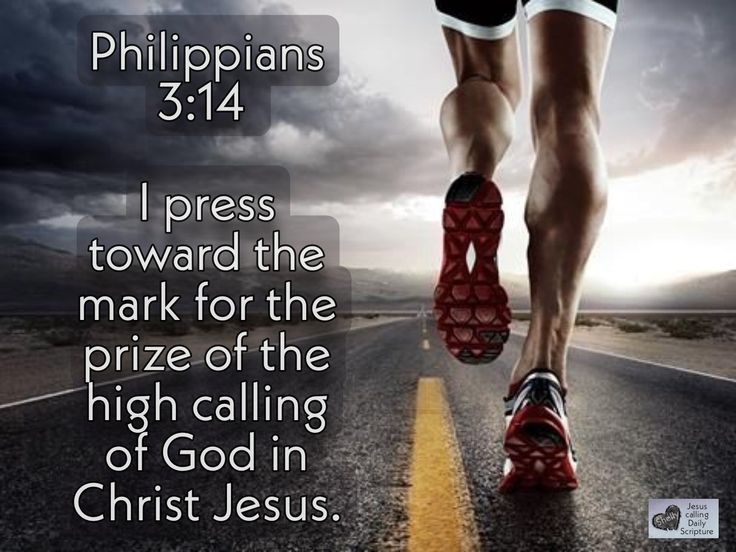
But one thing I do: forgetting what is behind and straining towards what is ahead, I press on towards the goal to win the prize for which God has called me heavenwards in Christ Jesus.
Paul’s ‘one thing’ fits nicely with the ease in which he counted everything as a ‘loss for Christ’ (vs7) and his pressing on to “take hold of that for which also I was taken hold of by Christ Jesus” (vs12). Paul has the ability to isolate that which is truly important and to focus all his attention and energy on pursuing that. He doesn’t allow distractions to distract him.
In a race, athletes understand they must not succumb to the temptation to look over their shoulder to see who is gaining on them. Each glance over the shoulder steals a bit of the runner’s energy and slows his or her pace just a fraction and might cost him or her the winner’s crown.
Paul applies those principles here. He chooses to forget “the things which are behind” – yesterday’s actions, yesterday’s accomplishments, yesterday’s sins. Yesterday is out of reach. Paul lets yesterday fall behind him – forgotten. Yes, yesterday’s accomplishments and yesterday’s sins were important then – and continue to resonate in our lives even today.
However, the person who spends too much time polishing yesterday’s trophies isn’t likely to win another trophy today or tomorrow. The person who is wallowing in yesterday’s guilt isn’t likely to have the energy to meet today’s challenges or to grasp tomorrow’s opportunities. We must be careful lest we allow our past to overwhelm our present and to sabotage our future. Paul is conscious of that danger and isn’t about to fall into that trap.
A runner in a 100m race could not expect to win a race while looking backwards. You will know that in a tight finish they lean towards the line and this straining towards what is ahead will contribute to the win. Especially in a photo finish. Paul applies that principle to his life. He runs the race of life straining towards what is ahead.
And what does he press forward to? For the prize for which God has called me heavenwards in Christ Jesus. Paul is talking about the highest calling of all – the call ‘of God in Christ Jesus.’ And Paul knew all about this, his call on the Damascus Road (Acts 9:1-21). His three missionary journeys – one of which brought him to Cyprus with Barnabas (Acts 13). And to write letters that constitute almost half of the NT.
Conclusion
In closing, Paul’s calling wouldn’t be all sweetness and light, of course. He often found himself in prison – in fact he writes this letter from a prison cell. He was beaten and stoned and shipwrecked. He often found himself in peril – from robbers, Jews, and Gentiles. He found himself in peril in cities and open country and on the sea. He suffered hunger, thirst, cold, and nakedness (2 Corinthians 11:23-27).
But, and we mustn’t miss the importance of this, Paul had seen the risen Christ, had experienced the power of the Holy Spirit working through his life and enjoyed God’s guiding hand. He considered his calling to be a prize worth living for and, if necessary, a prize worth dying for.
And finally, when Paul talked about forgetting what is behind and straining towards what is ahead, he was modelling the kind of life to which God calls each one of us towards the goal to win the prize for which God has called (us) heavenwards in Christ Jesus.
It’s said that the closer you are to the end of the race, the faster you run. May those of us who are coming closer to the end of the race of life believe the best is yet to come and continue to strain towards what is ahead.
Bob Dylan is one of my favourite artists and he converted from Judaism to Christianity in the late 70’s and released three Christian albums. They were full of profound theological insight (And even if you’re not a Dylan fan, his lyrics are worth reading themselves). In his 1980 Saved album he includes a song Pressing On based on these verses from Philippians 3. So, may we, in the words of Bob Dylan:
Keep pressing on to the higher calling of my Lord.
COPYRIGHT DISCLAIMER The text contained in this sermon (except where stated) is solely owned by its author, Revd Paul A. Carr. The reproduction, or distribution of this message, or any portion of it, should include the author’s name. The author provides free sermon resources in order to inspire believers and to assist preachers and teachers in building God’s Kingdom and making disciples.
I was going to the Bob Dylan version of Pressing On below, however, this is such a fantastic gospel version by the Chicago Mass Choir with Regina McCrary that I just had to use that instead. And, even if you’re not a Dylan fan, I guarantee you’ll love this!

