There was a time when terrestrial television dictated the rhythm of our evenings. A time when families gathered around a single screen and the arrival of a familiar theme tune promised an hour of escape.
For those of us who grew up in 90s Britain, ‘Star Trek: The Next Generation’ on BBC2 and Sky One became essential family teatime viewing.
Patrick Stewart belonged to that wonderful era when a television character could become part of the family.
TV has changed immeasurably since then. The shared anticipation of waiting for a favourite programme that almost everyone watched has largely disappeared with so many satellite channels to choose from.
We had known William Shatner’s James T. Kirk as the captain of the Enterprise. Then came Patrick Stewart’s Jean-Luc Picard, a Yorkshireman with the bearing of a Shakespearean king, a magnificent voice and an authority that seemed entirely natural.
He made the captain’s chair his own with his catchphrase ‘Make it so number one!’ Or ‘Engage’ – said right before sending the starship to warp speed. Or ‘Tea. Earl Grey. Hot’ – his standard order from the ship’s replicator.
And who will ever forget those opening words:
Space: the final frontier. These are the voyages of the Starship Enterprise. Its continuing mission: to explore strange new worlds, to seek out new life and new civilizations, to boldly go where no one has gone before.
A fun fact is that ‘Star Trek: The Next Generation’ was the most popular TV programme when I was at Theological College. Everyone and everything stopped at 6.00 pm on a Wednesday evening when it was aired.
It was popular, I think, because it was wholesome TV with a morality which echoed that of Jean-Luc, Commander Riker, Lieutenant Data, Deanna Troi and the rest of the crew. It was also ‘other worldly’ which fitted in with a Christian view of Jesus bringing with him a Godly morality of ‘kingdom values’ that was ‘out of this world.’
The Philosophy and Wisdom of Captain Jean-Luc Picard:
On Duty and Truth:“The first duty of every Starfleet officer is to the truth, whether it’s scientific truth, or historical truth, or personal truth!” (The First Duty)
On Failure:“It is possible to commit no mistakes and still lose. That is not a weakness, that is life.” (Peak Performance)
On Ethics and Rules:“There are times, sir, when men of good conscience cannot blindly follow orders.” (The Offspring)
On Morality:“The line must be drawn here, this far, no further!” (Star Trek: First Contact)
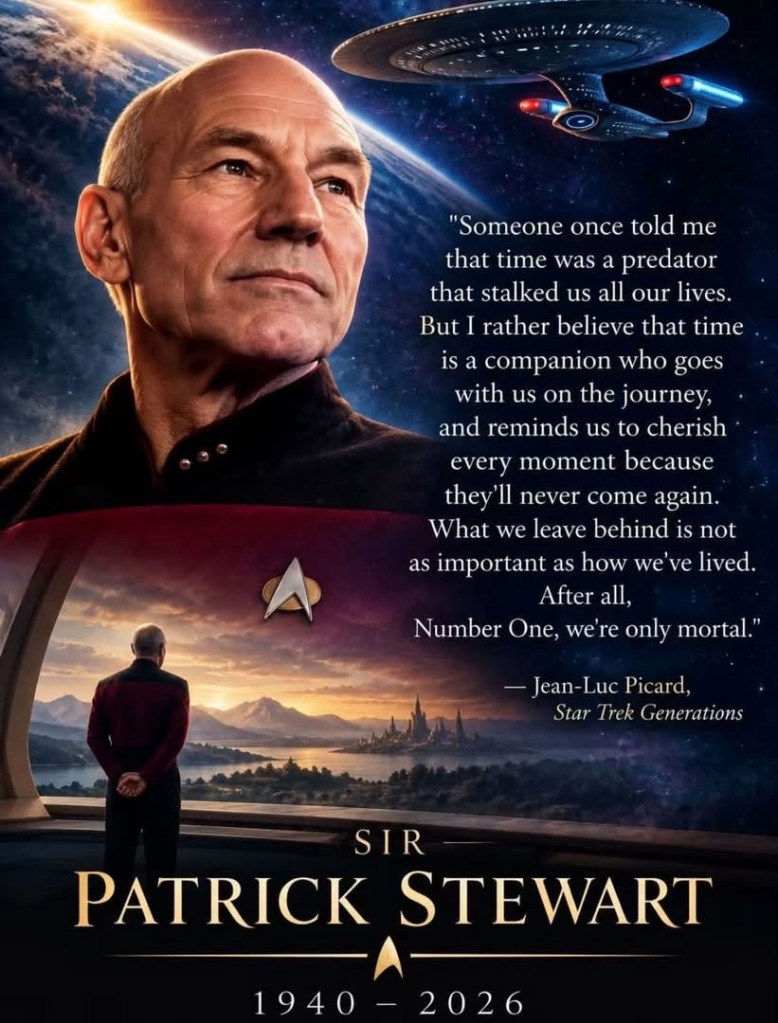
On Legacy:“What we leave behind is not as important as how we’ve lived.” (Star Trek Generations)
Stewart, of course, was an actor of extraordinary distinction. From the Royal Shakespeare Company (who can forget his mesmerising Shylock in ‘The Merchant of Venice?) to Professor Charles Xavier in X-Men, the Marvel Universe and his cameo in ‘Extras’ – Stewart’s was a career enriched by intelligence, dignity and immense versatility.
His farewell performance as Professor Charles Xavier in ‘Avengers: Doomsday’ is yet to be seen – it is due to be released on 18 December 2026.
Stewart’s compassion extended beyond the stage, particularly through his work supporting victims of domestic abuse – a response to growing up with a violent father in Mirfield, near Huddersfield, West Yorkshire.
Stewart often said his proudest moment was when he was appointed Chancellor of Huddersfield University.
A remarkable actor, a magnificent captain and a cherished companion to countless evenings. His death at 86 years of age on 29 October 2026, after a “brief and poignant journey with Alzheimer’s disease and Lewy body dementia” seems like the passing of an old family friend.
Rest in peace, Sir Patrick Stewart. Your mission is complete.