
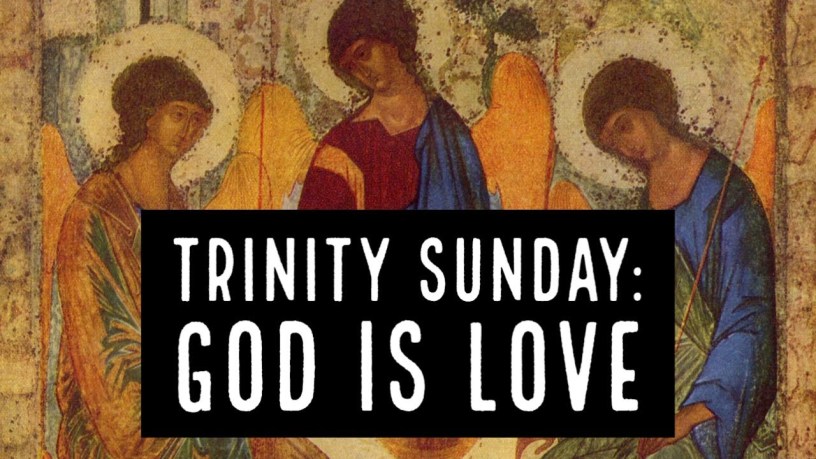
This is a copy of my talk given in the Anglican Church of Paphos on Trinity Sunday 31 May 2026. The Bible Reading was Matthew 28:16-20
Prayer
Heavenly Father,
I thank You for Your word.
By the power of Your Holy Spirit,
May You speak to my heart,
And change my life.
In the precious name of Jesus I pray.
Amen.
Introduction
I have a personal and thought-provoking question for you: Can you think of a time when you experienced being loved? It might be current, recent or a long lost memory. This was a question posed by American theologian Diogenes Allen when he asked a random selection of people about their experiences of being loved – and wrote a book based on their responses simply entitled ‘Love.’
A young woman described her experience as a little girl sitting on her father’s lap in a small church as her mother read the Christmas story from Luke’s Gospel. She would listen to those familiar words: “In those days Caesar Augustus issued a decree that a census should be taken of the entire Roman world … And there were shepherds keeping watch o’er their flocks by night and an angel of the Lord shone around them ….”
It was an experience of love for her: the message, her mother’s voice, her father’s embrace. She knew she was loved, and she knew, even more so, that her experience of earthly love was a mirror of God’s love for her. Don’t worry, I’m not about to launch into a Christmas Eve sermon this morning – but that might be much easier than preaching a Trinity Sunday sermon!
The Great Commission.
Jesus’ words in Matthews’s Gospel are known as The Great Commission. Interestingly, when I’ve sat on interview panels as Archdeacon one of the questions we ask candidates is: what do you understand Matthew 28:18-20 to mean? We then ask them to quote it – it’s amazing how many can’t! I would have thought they were some of the most significant words spoken by Jesus: “Go, teach, proclaim, baptise …” They are action-oriented verbs – doing words –and here Jesus articulates the call and mission given by the three members of the Godhead. We call it the Trinity, which simply means a group of three and is a term we use to describe God.
How Do You Describe The Indescribable?
But how do you describe the indescribable? Sometimes, as we seek to explain the meaning and significance of the Trinity, our words can do more harm than good. I’m sure you’ve heard some of them: the Trinity is like water with three states of solid, liquid and gas; the Trinity is like an egg with the elements of yoke and white and shell – distinct but somehow one. But all these attempts fall short.
For that reason, we say the Trinity is a mystery. But a mystery is not a problem to be solved or a whodunit. And that’s because the Trinity doesn’t exist to be explained or understood – it exists to be lived and experienced. I asked my initial question and shared that story for a particular reason, because it gets to the heart of what today, this reality of God as Trinity, is really about. It is simply about a relationship of love.
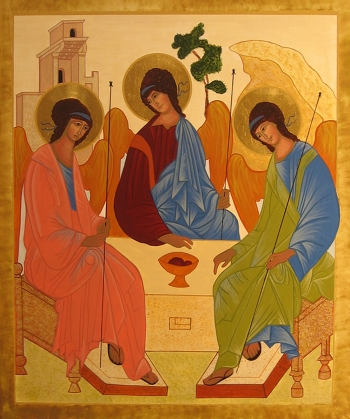
Andre Rublev: The Trinity
The famous icon by Andre Rublev communicates this more effectively than anything else. Rublev, who painted this in 1410, depicted The Trinity as three individual people. It was the first time anyone had depicted God as three distinct persons. The icon is painted in a way that invites us to join them, to share in the love that they find in each other, to participate in their life. That’s what a Trinitarian faith looks like – you and I finding our place in the love of God: Father, Son and Holy Spirit.
How Do We Measure Love?
All of this addresses central questions about our being loved. When have we been loved? By whom are we loved? How do we know that we have been loved? These are some of the most essential and important questions of our lives. A BBC survey suggested 78% of people would rather be loved than have money in the bank! There are more songs sung about it, poems written about it and escapist books romanticising about it than any other subject in the world – apart from Jesus. “Is there anything more important than love.” Most psychologists agree that man’s greatest need is to love and be loved.
How do we measure love? One of the songs from Jonathan Larson’s Pulitzer prize-winning rock opera ‘Rent’ – asks that question. Rent tells the story of a group of Bohemians struggling to express themselves through their art and “measuring their lives in love” in New York’s East Village in the late 80’s. The song ‘Seasons of Love’ wonders if love can be measured:
In daylights? In sunsets? In midnights? In cups of coffee?
In Inches? In miles? In laughter? In strife?
In truths that she learned or in times that he cried?
In bridges he burned or the way that she died?
The song also includes the line: “Remember that love is a gift from up above.” And so, it is. How do we measure love?
For God So Loved The World … (John 3:16)
For God so loved the world … Love is the central and primary theme of God’s salvation story. It is the heart and soul of the Gospel itself. Indeed, it is the belief that God loves us enough to create the whole universe and every creature and has given the human race the very breath of life.
It is the belief and experience that God loves us enough to send His only son to die on the cross to redeem/save the world from sin, sorrow, and separation so that we might be joined to that love forever. And it is the belief and experience that God loves us enough to be the Spirit God who is at work in us inspiring, strengthening, guiding, advocating, and illuminating us in our daily living. Which is what we celebrated on Pentecost Sunday.
So often we give the belief in God the Trinity over to academic theologians, and thank goodness there is intellectual reflection on this central reality of who God is. But this belief and experience belongs equally to poets, hymnists, artists, and storytellers. It belongs to all of us, because it describes the magnificent love that God has for us. And we are baptized into that love. We are welcomed into that love. We abide in that love in the Name of the Father, Son and Holy Spirit.
We are held in the arms and embrace of that love with all the warmth, care, and intensity described by that young woman who was sitting on her father’s lap and listening to her mother’s voice. To say, “I believe in God Father, Son, and Holy Spirit.” To say, “I believe in God the Creator, Jesus the Saviour and the Spirit of Life” is to say boldly and loudly, “I am loved … God loves me.”
It is to say, “God loves us. God loves this world. God loves everyone, everywhere and welcomes us all to God’s own embrace.”
Abiding In God’s Love
And the good news is that we are loved; we can know that we are loved; and we can know we are loved by God. We rest, we remain, we abide in God’s love throughout our lives and call upon that love in times of joy and sorrow and sadness and challenge. Believing in God as loving Creator, Redeemer, and Spirit also reminds us that our relationships are imbued with that love, and indeed that God participates in and cares very deeply about all of our relationships.
The picture and reality of God as Trinity is a sign of God as being a dynamic set of relationships in God’s own self and shoes us that God is not static nor disconnected. Rather, God’s very essence and being is dynamic and relational. That means that God is relating to the relationships of love that we experience in our own lives.
Just think back to that picture of that little girl in a loving embrace and hearing a loving voice. This is a family relationship. It is an experience of God’s relationship with us and of God in the midst of family, personal, and human relationships. The belief and description of God as Trinity mean something deep and profound in our own lives, and it means something deep and profound in the life and mission of the Church.
The primary call and purpose of the Church “Go, teach, proclaim, baptise is to announce and to proclaim that love to everyone, everywhere. This belief calls us to proclaim the love of God who creates, who redeems, and who inspires and directs human beings everywhere. This belief reminds the Church that loving relationship is both at the heart of God and at the heart of what it means to be the Body of Christ.
The writer and atheist Bertrand Russell once commented:
The only hope I can see for the future of mankind is what I, as an atheist, can only call Christian love.
The Agape love that comes from God. It seems to me: What the world needs now, is love sweet love … to solve our problems. Only the love of God, Father, Son and Holy Spirit can fill the missing piece in people’s lives. One of the most important decisions any person can make in their life is to be a follower of Jesus.
Conclusion
This love is an urgent love, propelling us to engage in the mission of proclaiming that love, of announcing it broadly and hopefully and confidentially and passionately and that, I guess, could easily sum up the purpose of my ministry over the last 29 years but, more so, my life since I became a Christian. And so it is for all of us. We are called to embrace God’s love and be embraced by it. We are called to believe it. We are called to proclaim it. We are called to invite people into the loving embrace of:
God the Father: who loves you and gives you life.
God the Son: who loves you and embraces you in that love forever.
God the Holy Spirit: who loves you and warms your heart and your soul with his love.
May the grace of our Lord Jesus Christ, the love of God and the fellowship of the Holy Spirit, be with us all, now and forever. Amen.
COPYRIGHT DISCLAIMER The text contained in this sermon (except where stated) is solely owned by its author, Revd Paul A. Carr. The reproduction, or distribution of this message, or any portion of it, should include the author’s name.

