
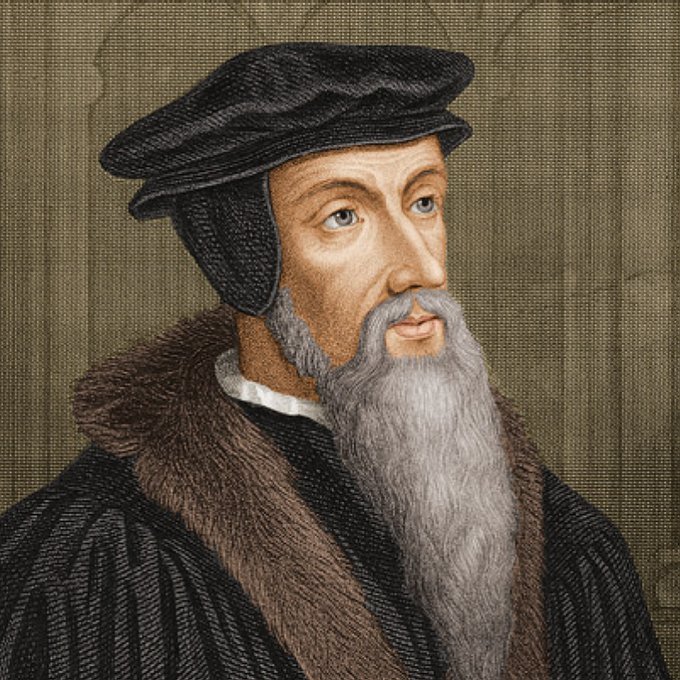
On 26 May the church remembers John Calvin, reformer, 1564.
But who was John Calvin?
Born at Noyon in Picardy, north-east France in 1509, Calvin studied law at Orléans, Bourges and Paris. He grew to appreciate the humanistic and reforming movements, and he undertook studies in the Greek Bible. He underwent a conversion experience in his mid twenties: ‘God subdued and brought my heart to docility. It was more hardened against such matters than was to be expected in such a young man.’
He renounced Roman Catholicism and left Paris with the intention of travelling to Strasbourg to study with the reformer Martin Bucer. But war made a lengthy journey via Geneva necessary and there the reformer Guillaume Farel prevailed upon Calvin to stay and work with him.
Thus began a love–hate relationship between Calvin and the people of Geneva. Indeed for three years (1538–41) Calvin sought refuge in Strasbourg after the Genevan citizens refused to swear loyalty to a Protestant statement of belief. While in Strasbourg, Calvin married Idelette de Bure, a widow. John Knox, who was hardly unbiased, described Geneva as ‘the most perfect school of Christ that ever was on the earth since the days of the Apostles’. Knox, like many others, experienced Geneva as a welcoming centre for Protestant refugees.
Though Calvin was never entirely successful in his attempts to enforce the Church’s moral discipline on the people, he sought to improve the life of the city’s citizens in many ways. He supported good hospitals, a proper sewage system, special care for the poor and infirm, and the introduction of new industries.
Calvin’s writings, however, have proven to be his most lasting contribution to the Church, in particular his massive yet easily readable work of Protestant systematic theology, The Institutes of the Christian Religion. The first edition was produced in 1536 and constantly enlarged until the final edition of 1559. Calvin stressed the sovereignty of God, the nature of election and predestination, the sins of pride and disobedience, the authority of Scripture, and the nature of the Christian life.
His theology was greatly influenced by Augustine. Calvin tried to steer a middle course between an exclusive emphasis on divine providence and an exclusive emphasis on human responsibility. His influence was felt widely elsewhere in Europe, including England and Scotland.
Calvin’s health was never robust (he was a chronic asthmatic) and he became very frail after an attack of fever in 1558. He died on 26 May 1564 and, at his request, was buried in an unmarked grave in Geneva.
A Prayer of John Calvin
Grant, Almighty God, that as we must in various ways carry on a warfare on earth, we may be animated by the power of Thy Spirit, so as to go on through fire and water, and be ever so subject to Thee, that relying on Thine aid, we may never hesitate to face all perils of death, all troubles, all reproaches, and all the terrors of men, until having at length gained the final victory, we shall come to that blessed rest, which Thine only-begotten Son hath procured for us by His own blood. Amen.
Rev Paul A. Carr and extract from Saints on Earth: A biographical companion to Common Worship by John H Darch and Stuart K Burns

