
This is a copy of my talk given in the Anglican Church of Paphos on Sunday 9 August 2026. The Bible Reading was Matthew 14:22-33.
Prayer
Heavenly Father,
I thank You for Your word.
By the power of Your Holy Spirit,
May You speak to my heart,
And change my life.
In the precious name of Jesus I pray.
Amen.
This morning we look a little closer at an incident in the life of the disciples but especially the Apostle Peter, recorded in Matthew, Mark, and John which demonstrates how desperation and paralysing fear can result in a deeper faith.
Matthew writes vs22-23: Jesus made the disciples get into the boat and go on ahead of him to the other side, while he dismissed the crowd. After he had dismissed them, he went up on a mountainside by himself to pray.
Jesus made the disciples get into the boat. Why? Well, because of what had just happened! Jesus had just fed the 5000. The atmosphere would have been electric. Messiah fever was in the air. Jesus wanted to escape. In fact, Jesus wanted to spend time in prayer. So, the disciples are bundled into a boat, the crowds are told to go home, and Jesus climbs a mountain to pray.
Now, we are told in vs23 “When evening came, he was there alone, but the boat was already a considerable distance from land, buffeted by the waves because the wind was against it.’ It was probably around 6.00 pm, and that is when the storm struck with shocking immediacy – as they apparently do on Lake Galilee. Matthew as a landlubber of a tax collector, rather than a fisherman, must have been scared witless by what was going on.
And so, the disciples began what was, for some of them, the worst night of their lives. A dark night: a rough sea and a situation which seemed hopeless. The one who could save them wasn’t with them.
Remember they’d been in a storm together before back in chapter 8, but that was different because Jesus was with them in the storm and he stilled the storm, but what possible hope could they have that he will rescue them this time? Even if he wanted to help them, he couldn’t. After all, what chance was there of him getting hold of a boat and reaching them in time? So, for nine agonising hours they struggled with no end in sight.
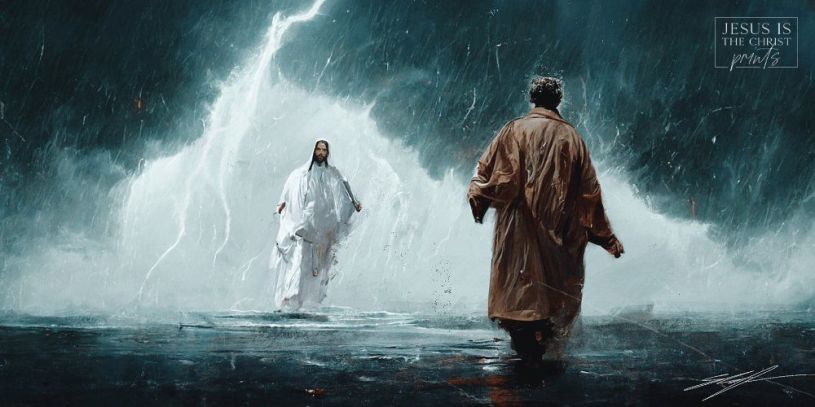
Then, just before dawn, at around five o’clock in the morning, the impossible happened, Jesus came! Vs25-27: “During the fourth watch of the night Jesus went out to them, walking on the lake. When the disciples saw him walking on the lake, they were terrified. “It’s a ghost,” they said, and cried out in fear. But Jesus immediately said to them: “Take courage! It is I. Don’t be afraid.”
Now, isn’t that just the way it goes? There you are in the Christian life, wanting to obey Jesus – just like these disciples had done – and a storm suddenly breaks: We lose a loved one. A family member gets ill. That job is lost.
And that, of course, is when faith is tested. When God says, ‘Will you trust me now? When it is dark and you can’t see. When you have exhausted all your own resources and have nowhere else to turn. Will you trust me?’
But what we see here is things going from bad to worse; at least that is the way it seems to the disciples. Battling against nature is one thing, but to be suddenly confronted with the supernatural almost drives them over the edge. ‘It’s a ghost!’ and ‘they were terrified!‘
But Jesus doesn’t allow them to remain in this state for very long, does he? Immediately the reassuring voice of the master is heard, and he speaks into their chaos: ‘Take courage, do not be afraid, it is I.’ It strikes me that Jesus is wanting to still the storm raging within their hearts before he stills the storm raging in their lives.
And that is exactly what he does today. When the tragedy strikes, when circumstances are difficult – we can still hear him speak through his word, through prayer and through Christian brothers and sisters around us and through the still small voice of calm.
There was certainly one man in the boat who really believed it was Jesus and that was Peter vs28-29: “Lord, if it’s you,” Peter replied, “tell me to come to you on the water.” That is more like the Peter we know. “Come,” he said.’ Then Peter got down out of the boat, walked on the water and came toward Jesus.’ And what propelled Peter out of that boat was more fear than faith. He, like the rest of the disciples, was at his wits end.
Do you think that had Peter seen Jesus walking on the water during a calm, peaceful summer’s day, he would have shouted to Jesus, ‘Jesus, do you mind if I join you’ and made his way out? Hardly. If the lake had been carpet smooth and the journey pleasant, do you think Peter would have gone out to join him then? No! And neither do I.
John Ortberg has written a famous book: If you want to walk on water you’ve got to get out of the boat. It’s a call to action, urging us to overcome our fear and to trust in God’s power. He writes: “The greatest risk is not taking any risk.” Playing it safe may seem appealing, but it ultimately leads to stagnation and regret. Taking risks, even small ones, is essential for growth and fulfilment.
Ortberg suggests a number of principles that we can apply to our lives (you can read about these in greater depth on my website): Embrace Risk; Cultivate Faith; Challenge Conformity; Learn from Failure; Focus on Transformation; Trust God’s Timing; Practice Contentment; Keep Your Eyes on Jesus. You can read a bit more about these principles below:
These are just a few examples of how you can apply the John Ortberg if you want to walk on water principles to your daily life. The key is to be intentional and proactive, consistently seeking to live a life of faith, courage, and purpose. Remember that walking on water isn’t about avoiding the storms; it’s about trusting God to carry you through them.
The John Ortberg if you want to walk on water philosophy is a lifelong journey, not a destination. It requires ongoing commitment, perseverance, and a willingness to embrace the unknown. By consistently applying these principles, you can experience the extraordinary power of God in your life and live a life that is truly fulfilling and meaningful. It’s a call to step beyond the ordinary and embrace the extraordinary possibilities that God has in store for us.
- Embrace Risk:Identify one area in your life where you’ve been playing it safe. What’s one small step you can take to step outside your comfort zone and pursue a dream or goal?
- Cultivate Faith:Spend time in prayer and scripture, focusing on building your relationship with God. Practice gratitude and actively look for evidence of God’s faithfulness in your life.
- Challenge Conformity:Identify areas where you’re simply going along with the crowd. What are your unique values and beliefs? Have the courage to stand apart and live authentically.
- Learn from Failure:When you experience setbacks, don’t dwell on your mistakes. Instead, ask yourself what you can learn from the experience and how you can grow stronger.
- Focus on Transformation:Prioritize personal growth and character development over outward achievements. Seek to become the person God created you to be.
- Trust God’s Timing:Release control and trust that God is working behind the scenes, even when you don’t understand His plans.
- Practice Contentment:Cultivate gratitude for what you already have and resist the temptation to constantly compare yourself to others.
- Keep Your Eyes on Jesus:In the midst of challenges, focus on God’s love and faithfulness. Seek His guidance and trust that He will see you through.
And so, Peter frantically throws out one leg out of the boat, and then the other, and shakily makes his way towards Jesus. And when you think about it, we do the same don’t we? Yes, it may be a scary thing to stop putting faith in ourselves and start putting faith in Jesus. We hear his voice in the Gospel and we take the step.
But for many of us, having taken that first step we are confronted with another challenge and it is there in vs30-31: ‘Then Peter got down out of the boat, walked on the water and came toward Jesus. But when he saw the wind, he was afraid and, beginning to sink, cried out, “Lord, save me!” Immediately Jesus reached out his hand and caught him. “You of little faith,” he said, “why did you doubt?”
Did you notice at what point Peter began to sink under the waves? The point at which Peter began to sink, is when he began to notice what was happening around him. He forgot to keep his eyes fixed in Jesus. That is the challenge facing us, too. We begin to sink when we take our eyes off Jesus and begin to dwell on the troubles going on around us. Nothing had really changed from the moment Peter climbed out of the boat. The wind was still howling, the waves were still breaking and Jesus was still standing. It wasn’t as if all was calm and then the wind got up and so his faith failed. No, faith is refusing to be overwhelmed by the circumstances and actively trusting in the Lord of the circumstances.
But did you notice how even when Peter panicked and he began to drown, he still cried out to Jesus and Jesus stretched out his strong hand and caught him? Sure, the gentle rebuke came later, v31, ‘Peter why did you doubt? Why didn’t you trust me?’
I want to tell you about a man called John. He, like Peter was a sailor and had been at sea since he was eleven years old. His father, a shipmaster in the Mediterranean, took him aboard and trained him well for a life in the Royal Navy. In his early twenties he made his way to Africa, where he became involved in making a small fortune in the lucrative slave trade. At 21 he made his living on the Greyhound, a slave ship crossing the Atlantic Ocean.
That was to prove the worst and best night of John’s life. The waves so pummelled the Greyhound that John woke up to find his cabin filling with water. He set to work the pumps. For nine hours he and the other sailors struggled to keep the ship afloat. But he knew it was a lost cause. And so, he threw himself on the watery deck and pleaded, just like Peter had done and cried, ‘If this will not do, then Lord have mercy on us all.’ Of course, John didn’t deserve mercy, he just received it. He and the crew survived.
John never forgot that moment, a moment which changed his whole life. He gave up the navy and joined the church, becoming one of the most influential preachers of his time – do you know who this John is? John Newton.
As well as being an influential preacher he was also a prolific hymn writer and penned the classic ‘Amazing Grace.’ During his last years, John Newton said “My memory is almost gone but I remember two things: I am a great sinner, and Jesus is a great Saviour.” This echoes the words of the disciples in vs33 when they said, ‘Truly you are the Son of God.’
Today’s gospel reading is a well known story but it’s is a simple story, one that reminds us of this simple, glorious truth: Jesus is with us in the midst of the storms. We can prepare for some of life’s storms. But many of the storms of life hit immediately and unexpectedly. And when they do, it is good to remember this story. It is good to remember that whenever we cry out in fear to the Lord, he immediately answers our prayers with the promise that he is with us. And when we take our eyes off Jesus and become overwhelmed by what is happening in our life, it is good to remember that Jesus will be right there to catch us.
It is no wonder that when all of this was said and done, those in the boat worshiped Jesus, saying, “Truly you are the Son of God.” That is why we worship, isn’t it? To take a moment in the midst of our journey through life, to gather on this little boat called faith, and to worship the one who promises to be with through every storm.
And may each of us in the coming week, whatever life brings our way, whether we are going through a storm or experiencing a period of calm, keep our eyes fixed on Jesus.
COPYRIGHT DISCLAIMER The text contained in this sermon (except where stated) is solely owned by its author, Revd Paul A. Carr. The reproduction, or distribution of this message, or any portion of it, should include the author’s name.

