
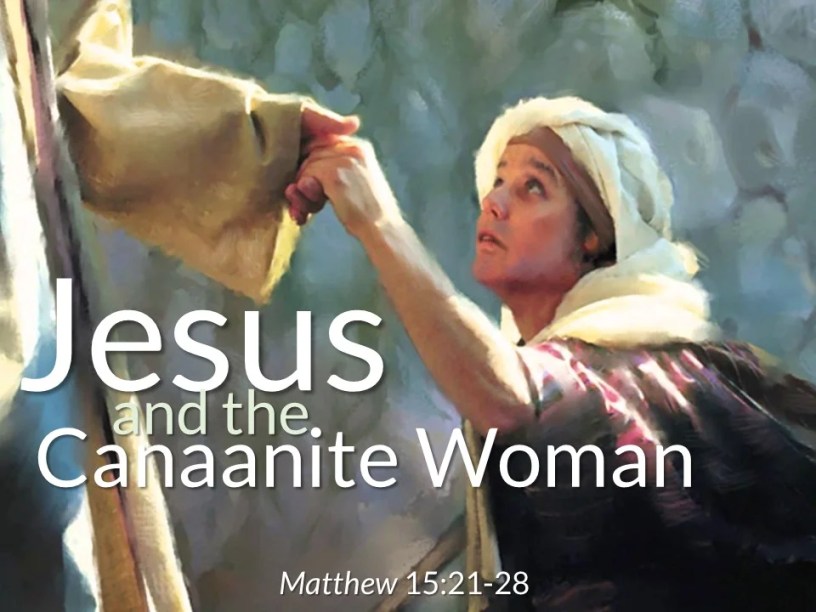
This is a copy of my talk given in the Anglican Church of Paphos on Sunday 16 August 2026. The Bible Reading was Matthew 15:21-28.
Prayer
Heavenly Father,
I thank You for Your word.
By the power of Your Holy Spirit,
May You speak to my heart,
And change my life.
In the precious name of Jesus I pray.
Amen.
Introduction
I don’t know about you, but I get weary at the constant headlines of war and conflict and natural disasters in so many countries/regions in our world today. And especially the unrest in our Province and Diocese. It seems as though it will never end. It all becomes a little overwhelming and exhausting at times, and also, rather inescapable. Which is why I find today’s gospel reading so refreshing.
Eugene Peterson once said that, for Christians, the Bible should never be the footnote to the news of the day; but rather the day’s news should always be the footnote to the Bible. “If we forget that the newspapers are footnotes to Scripture and not the other way around, we will finally be afraid to get out of bed in the morning.” So, what is today’s headline?
An unnamed Canaanite woman is described by Jesus as having great faith.
It’s a story about a woman who couldn’t care less about all the politics and division in her world. She cares only about her daughter. The daughter she carried in her womb. The daughter for whom she went through the pain of childbirth. The daughter she nursed, fed and washed. The daughter she watched grow, take her first step, say her first word. She will do anything to see her daughter healed. And her story reminds us of what faith and prayer and love looks like when we are faced with personal adversity. It’s a story that brings us back to the basics of what it means to trust in Jesus.
Just last week, Peter, was told that he had very little faith. This week, an anonymous woman, who is not even Jewish, is told that she has great faith. Interestingly, there’s only two (unnamed) people in Matthew’s Gospel who are commended for their great faith and they are both Gentiles. The Canaanite woman here and the Roman Centurion in Matthew 8:5-13.
When Peter was caught in the storm, he took his eyes off Jesus and began to sink. When this woman is caught in a very different storm, she stayed focused on Jesus and fell to her knees before him. So, what is it about this woman’s faith that makes it great? And how can we have faith that is great like hers? This morning I want to look at three things she shows us as being necessary to have this faith; and one thing that is not.
- Great Faith Requires A Great Need
First of all, this woman’s story reminds us that great faith often requires a great need. If we don’t need Jesus greatly, then how can we ever have great faith in him?
Throughout the New Testament, the people who show the greatest faith in Jesus are the ones who need him the most: the ones who are ‘poor in Spirit’ as Jesus describes them in the Sermon on the Mount: Blessed are the poor in spirit, for theirs is the kingdom of heaven. Great faith requires being poor in spirit. It requires recognising that we need Jesus. Realising that we don’t have it all figured out. That we can’t get it right. That we can’t fix ourselves, our families, or our world, on our own. We need Jesus. And we know it.
This woman is desperate. Her daughter is being tormented by a demon. And she will do anything for her daughter. She will humble herself and embarrass herself. She will do whatever it takes, because her need is that great. She would even turn to a Jew. But need by itself is not enough.
- Great Faith Requires Knowing Who Will Fill That Need
There are lots of people in our world who know they need something, but they don’t know exactly what they need. So, they try this, and they try that, but nothing seems to satisfy. It seems like a lot of our world’s attention is focused on what will fill our need. They are looking in the wrong places and getting the wrong answers to the wrong questions!
But the truth is there is a God shaped hole in the heart of our world that can only be filled by Jesus. Great faith requires a great need. The Canaanite woman has great faith, not just because she is desperate for help, but because she comes to realize that her help can only come from Jesus. Great faith means recognising our greet need and turning to our great Saviour. Knowing what we need something and knowing who alone can fill that need.
- Great Faith Requires Persistent Trust
But there is a third element necessary to having great faith. Did you notice that when this woman first turns to Jesus, he ignores her? He doesn’t answer her at all. That seems strange, doesn’t it? But have you ever felt that way when you’ve prayed? I know that I have.
There is a classic little book on prayer called “Beginning to Pray,” by Anthony Bloom, and he thought this was so important that he devoted the very first chapter of his book to it and gave it the title, ‘The Absence of God.’ He knew that God was never truly absent, and that God hears all of our prayers. But sometimes the only answer we seem to hear is silence. And that makes it seem as though God is absent. And that can test and challenge our faith, can’t it?
When Jesus responds to her request with silence, she responds to his silence with faith. In the face of silence, she does not give up. She does not turn from Jesus. Instead, she kneels before Jesus, and says again, “Lord, help me.”
Great faith does not give up, but persists, even when there seems to be little reason to do so. Sometimes I wonder whether Jesus intentionally ignored this woman – to show his disciples what a great and persistent faith looks like.
In summary, great faith requires a great need, and trusting that Jesus alone can meet that need, and it requires persistent trust in God even when God does not seem to be responding to our prayers. But there is one thing great faith does not require – and we see that through the strange twist this story takes.
- Great Faith Does Not Require Our Worthiness
When this woman finally does get Jesus’ attention, he gives her an answer she doesn’t want to hear: “I was sent only to the lost sheep of the house of Israel.” And she was not one of those lost sheep. She was a Canaanite. She was a woman. She worshiped the “wrong god,” and Jesus’ mission was not yet for people like her. There would come a time when his mission would be for all nations, and for all peoples – after the resurrection – but not yet.
Then comes the sharper word: “It is not right to take the children’s bread and toss it to the dogs.” In that culture “dog” was a common Jewish term of contempt for Gentiles.
So why was Jesus so uncharacteristically rude? Well, his disciples had wanted him to send the woman away, presumably because of the fuss she was making, but more probably because she was not one of them. It seems to me that Jesus threw all their prejudices at the woman, both as a way of confronting his disciples with the ugliness of their prejudice.
Many of us would have walked away offended. This woman does not. She accepts the metaphor and turns it into a beautiful confession of faith: “Yes, Lord … even the dogs eat the crumbs that fall from their master’s table.” She doesn’t argue that she deserves a place at the table. She simply trusts that there is enough grace in the Master’s house for even the crumbs – and that those crumbs are sufficient.
So, why would Jesus say that to her, and what does that have to do with us? Sometimes, when we don’t get the answer we want in prayer, we can blame ourselves. We haven’t lived a good enough life. We haven’t had enough faith in God. We have disappointed God in some way. Who are we to even dare to ask God for help? Like the Canaanite woman, we can wonder if we are really worthy to have our prayers answered.
But here’s the good news that this Canaanite woman teaches us: Our worthiness has nothing to do with it. She is not worthy. And neither are we. But it doesn’t matter. Great faith doesn’t require us to be worthy. Because great faith turns us to the only one who can make us worthy. Great faith turns us to the one who died for us, to make us worthy to stand before him.
By telling the Canaanite woman she isn’t worthy, and then answering her prayer, Jesus is telling us that it is not about our worthiness. It never was. It’s about grace. The simple gift of God’s love given to all of us by God’s Son.
When I studied for my MA, I wrote my dissertation on Community, Neighbourhood and Faith. As part of this I put together a couple of surveys, one for church members and one for those who had no church connection. The research suggested 35% of non-church attendees said they’d received an answer to prayer. And these weren’t church attenders. Amazing! Great faith doesn’t rely on our worthiness, but it’s also not stopped by our unworthiness. Great faith relies on God. Nothing more. Nothing less.
Conclusion
If we were part of this story, would we be with the disciples who wanted Jesus to send the Canaanite woman away because she was not one of them? Or would we be with Jesus who challenged the prejudices of his disciples by pointing out the depth of faith which he had uncovered in a woman of another race, culture and faith.
This story challenges both our pride and our small faith. It confronts any tendency to exclude those who seem ‘on the outside.’ Jesus says to this unnamed woman: “Woman, great is your faith.” Not because she was worthy of it. But because she needed Jesus. And she persisted when everything, and everyone, was telling her to give up.
An unnamed Canaanite woman is described by Jesus as having great faith.
It may not be the most important story in the world, in the grand scheme of things. And it’s not a new story. It certainly won’t make tomorrow’s headlines.
But, then again, think of how many people will be hearing this story today – 90 million Anglican’s around the world will be hearing about a Canaanite woman, whose name we do not know, who showed us what it means to have great faith. People of all races and nations. Young and old. Rich and poor. Sick and well. People like you and me, who, themselves, might be overwhelmed by the stories in the news.
So, maybe this story is the most important story in the world today. The one that should be given the headlines. And I, for one, am thankful to have heard it. And thankful to share it with you.
COPYRIGHT DISCLAIMER The text contained in this sermon (except where stated) is solely owned by its author, Revd Paul A. Carr. The reproduction, or distribution of this message, or any portion of it, should include the author’s name. The author provides free sermon resources in order to inspire believers and to assist preachers and teachers in building God’s Kingdom and making disciples.

