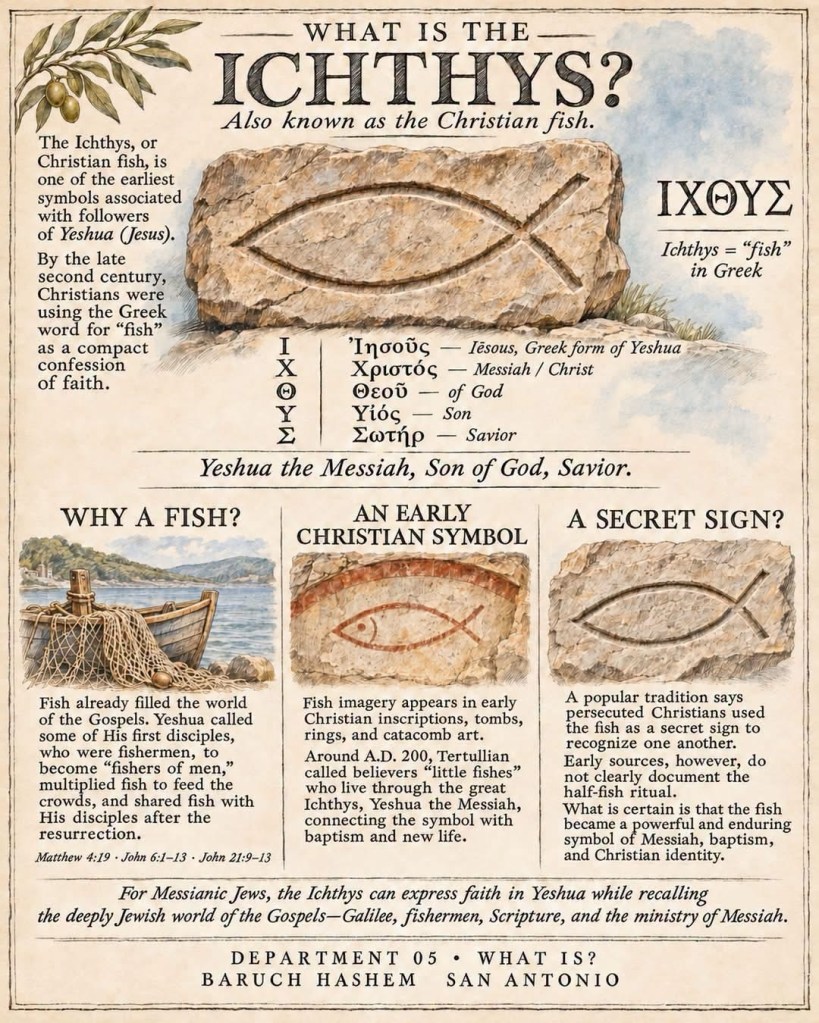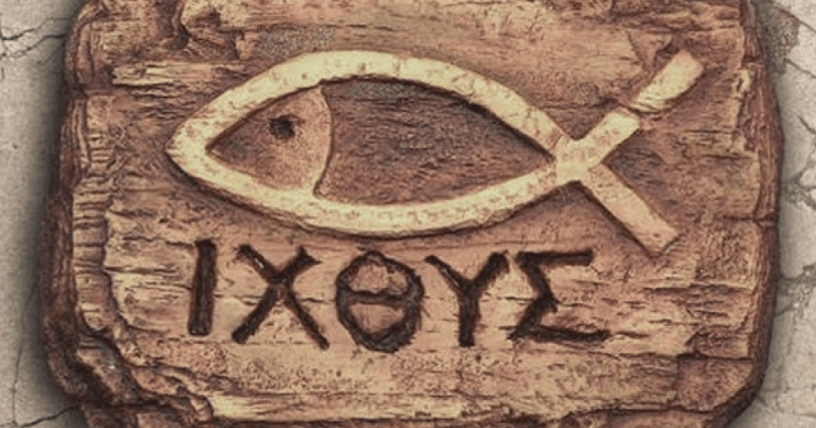
Five Greek letters. One fish. An extraordinary confession of faith.
You’ve probably seen the familiar fish symbol on cars, jewellery, church signs, or ancient Christian artwork.
But where did it come from?
The symbol is known as the Ichthys (ΙΧΘΥΣ), the Greek word for “fish.” For early followers of Yeshua (Jesus), these five letters came to express a remarkable declaration of faith.
Each letter represents a Greek word:
Ι — Ἰησοῦς (Iēsous) — Yeshua
Χ — Χριστός (Christos) — Messiah / Christ
Θ — Θεοῦ (Theou) — Of God
Υ — Υἱός (Huios) — Son
Σ — Σωτήρ (Sōtēr) — Savior
Together, they proclaim:
Yeshua the Messiah, Son of God, Savior.
The symbolism is especially fitting when we consider the world of the Gospels.
Several of Yeshua’s earliest disciples were fishermen from Galilee. He called them to become “fishers of men” (Matthew 4:19). Fish appear in the miraculous feeding of the crowds, and after His resurrection, Yeshua shares a meal of fish with His disciples beside the Sea of Galilee (John 21:9–13).
By the late second century, fish imagery was already part of Christian religious expression.
Clement of Alexandria recommended the fish as one of several suitable designs for Christian signet rings. Around AD 200, Tertullian described believers as “little fishes,” drawing a connection between the great Ichthys, Messiah Himself, and the waters of baptism.
But what about the famous secret-sign story?
You may have heard that persecuted Christians drew half a fish in the sand, waiting for another believer to complete the symbol.
It’s a memorable tradition, but surviving early Christian sources do not clearly document that particular recognition ritual.
What we can establish is that fish imagery appeared in early Christian inscriptions, funerary art, and personal objects.
For Messianic Jews, the Ichthys also recalls the deeply Jewish setting of the Gospels: Galilee, fishermen, the Scriptures, and the Jewish Messiah whose followers carried His teachings into the wider world.
An ordinary Greek word became a compact expression of faith that has endured for nearly two thousand years.
And its documented history is every bit as fascinating as the legends surrounding it.